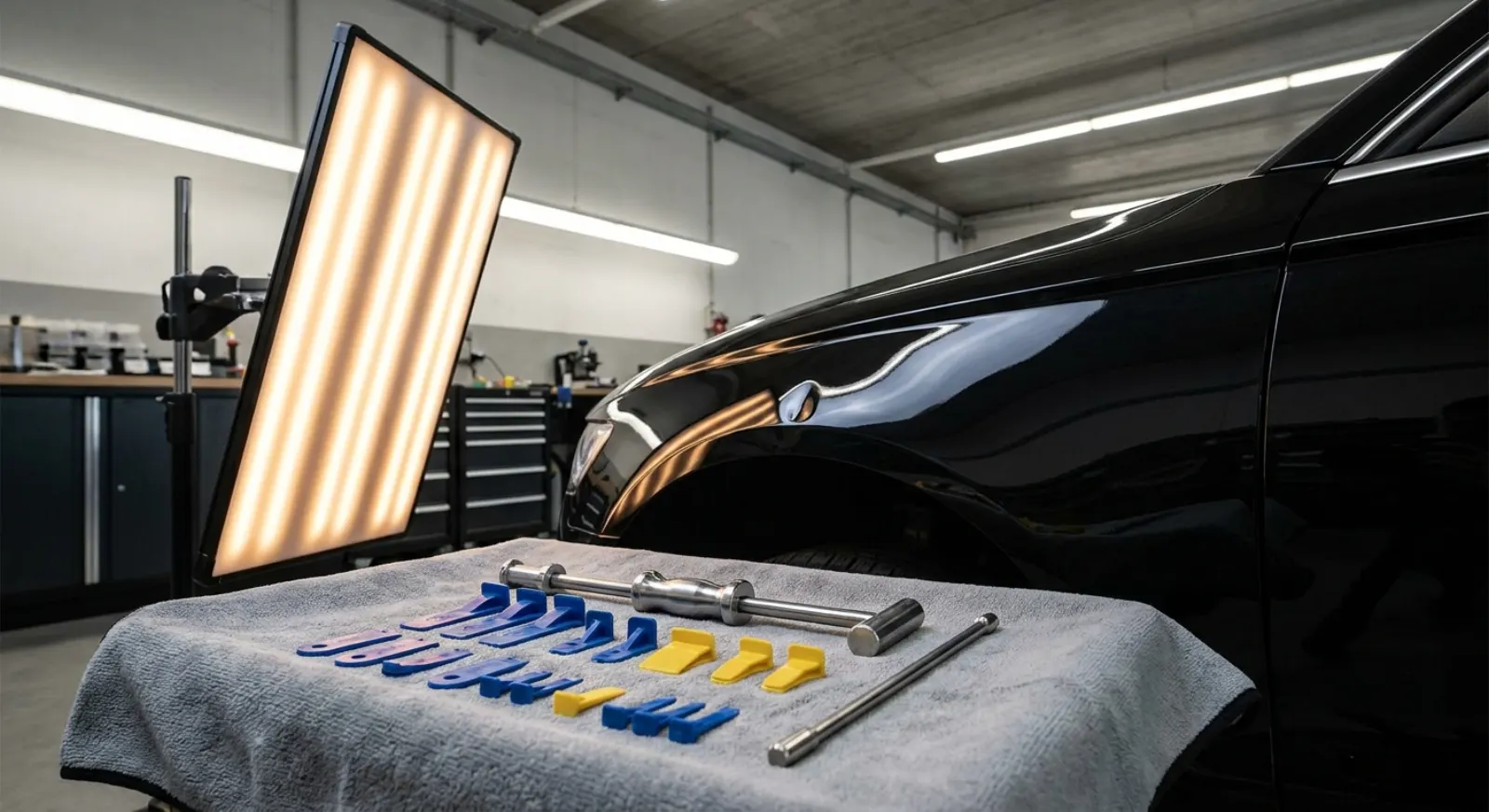

Most people's first thought when they see a dent in their car is: is this $50 or is this $500? The honest answer is "it depends," but here's a real breakdown of what paintless dent repair (PDR) actually costs in the DMV in 2026, including the factors that swing the price up or down.
Quick answer: PDR price ranges
| Damage size | Typical PDR cost | Body shop comparison |
|---|---|---|
| Small door ding (dime-sized) | $75-$125 | $300-$600 |
| Medium dent (golf-ball to baseball) | $150-$275 | $500-$1,000 |
| Large dent or simple crease | $300-$500 | $800-$1,500 |
| Hail damage (full car, 20+ dents) | $1,500-$3,500 | $5,000-$10,000+ |
These are real numbers, not ballpark fantasies. A door ding in Alexandria or Arlington is going to cost you between $75 and $125 from a skilled mobile PDR tech. Not $300, not $40. If someone quotes you significantly outside this range, ask why.
What actually affects the price
1. Size and depth
Size matters, but depth matters more. A shallow 4-inch dent on flat metal is easier to fix than a deep 1-inch crease. Techs price based on how hard it'll be to work the metal back, which is size × depth × accessibility.
2. Location on the panel
Panel edges are harder than panel centers. Edges often require specialty tools or glue-pulling (pulling the dent from outside instead of pushing from inside). A dent smack in the middle of a door is the cheapest scenario. A dent on the edge of a fender or near a body line? More expensive.
3. Body line crossing
Body lines (the creases Honda Civics and Teslas and every modern car have down their sides) are a nightmare if a dent crosses one. Realigning the body line exactly adds serious time. Crease dents on body lines can easily double the price of a simple round dent of the same size.
4. Aluminum vs. steel
Aluminum panels (common on Ford F-150s, Range Rovers, Teslas, and most luxury cars post-2018) are much harder to work than steel. They have "memory." They try to pop back to shape on their own, which sounds great but actually makes precise shaping harder. Budget 20-40% more for aluminum panels.
5. Access to the back side
PDR requires working the back side of the panel. If that means dropping the inner liner, removing a tail light, or accessing through a window, each step adds time. Quarter panels in particular can be tricky. Some require partial interior trim removal.
When PDR isn't cheaper than a body shop
It's rare, but here are the cases:
- Paint is cracked or chipped. PDR keeps factory paint intact. That's the whole point. If the paint is already damaged, you're paying for PDR plus a touch-up, and at that point a full body shop repaint of just that panel might be cleaner.
- Dent is stretched too thin. Very deep dents can stretch the metal past the point where it can be pushed back to original shape without cracking. A tech will tell you: if we try PDR and the metal has memory loss, you'll see it.
- Structural damage. If the frame is bent or the panel's mounting points are compromised, skip PDR. You need a shop.
Mobile PDR vs. shop PDR: does it cost different?
Mobile PDR is usually 10-30% cheaper than shop PDR. The reason: mobile techs don't have the overhead of a shop lease, front-desk staff, or insurance on a facility. Same skill, same techniques, lower overhead = better price for you.
The tradeoff: at a shop you can drop the car and leave. Mobile techs come to you, which is faster for the customer but means you need to be available for 1-2 hours.
Insurance and PDR
Most insurance companies prefer PDR for covered repairs (hail damage, minor collision) because it costs them less than a body shop. If you have a claim, ask specifically for PDR. Most legitimate mobile PDR shops will invoice insurance directly.
For small out-of-pocket repairs (single door ding or two), it's almost always not worth filing a claim. The deductible is usually higher than the repair cost.
How to get an accurate quote
The only reliable way is a photo. A skilled PDR tech can look at a photo of the damage (in good lighting, with at least two angles) and give you a price within 15% of the final number. Here's what to send:
- Photo of the damage in daylight, from 2-3 feet away
- A second photo from a low angle showing the depth
- The make, model, and year of your car
- Where on the panel the damage is (door, fender, hood, etc.)
At The Dent Dude, we text back a quote within 15 minutes during business hours. Free. No obligation. Text us at (703) 975-9626.
Bottom line
PDR for small to medium dents in the DMV should cost between $75 and $500. Body shops for the same damage typically cost 2-4x more. If the paint is intact and the damage isn't structural, PDR is almost always the right call, and mobile PDR is almost always the cheapest legitimate option.
More context before you book: see which dents PDR can fix vs which need a body shop for a clean go/no-go check, how long the work actually takes for scheduling, and mobile vs shop comparison if you're deciding where the work happens. If your car is a Tesla, F-150, Range Rover, or any aluminum-bodied vehicle, read why aluminum panels cost 30-50% more first. For hail damage specifically, our DMV hail repair guide covers the full insurance-claim path.