Mobile Auto Body & PaintCall (703) 975-9626
Cost & Pricing

Car Rust Repair Cost 2026: Real DMV Prices by Rust Type

June 17, 2026 · 10 min read · by The Dent Dude team

How to Repair Rust on Your Car Without Welding (No Special Tools Needed)
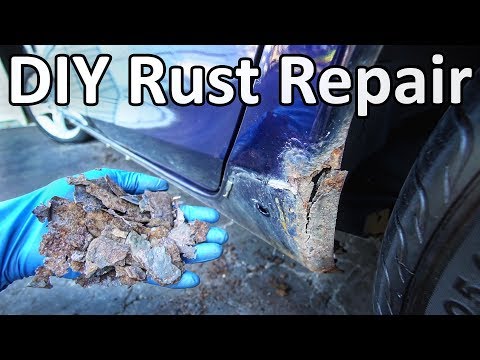
ChrisFix's canonical 22-minute walkthrough of surface and bare-metal rust repair using common shop tools. Useful baseline for what the work looks like before you decide DIY vs mobile body and paint vs body shop.

Short version: Car rust repair in the DMV in 2026 runs $75 to $350 mobile for a surface rust spot caught early, $300 to $900 for scale rust that has lifted the paint, $600 to $1,800 body shop for penetrating rust through the panel, and $1,500 to $4,500 body shop for structural rust where the panel has to be cut out and a patch welded in. The honest pricing depends almost entirely on rust depth, not rust diameter. A 2-inch surface rust spot is a $150 fix. A 1-inch hole all the way through the rocker panel is a $1,200 fix. After 20+ years working out of DMV driveways and partnering with body shops across Alexandria, Arlington, Fairfax, Falls Church, and McLean, here is the real cost math by rust level, why DMV cars rust faster than the national average, the three-question test I run before quoting, and the four mistakes that turn a $150 rust spot into a $2,000 body shop bill.

How much does car rust repair cost in the DMV in 2026

Rust repair cost moves on three things: how deep the rust goes (surface, under-paint scale, penetrating, or structural), what panel the rust is on (a flat door is cheaper than a wheel arch is cheaper than a rocker panel is cheaper than a frame rail), and whether the rust has reached bare steel. The table below is what I actually charge mobile in DMV driveways for the work that stays in mobile body-and-paint territory, what the body shops up the road quote on the same damage, and the time on each.

Rust typeMobile (DMV)Body shop quoteTime
Surface rust, paint chip with rust started, under 1 inch$75 to $200$300 to $55045 to 90 min
Surface rust cluster, 3 to 8 small spots$200 to $400$550 to $1,10090 min to 3 hours
Scale rust under paint, lifting clear coat, 2 to 4 inches$300 to $700$700 to $1,4002 to 4 hours
Scale rust on a wheel arch or rocker, larger than a palm$500 to $900$1,000 to $1,8004 to 6 hours
Penetrating rust, pinhole through the panelNot a mobile job alone$700 to $1,400Body shop, half day
Penetrating rust, hole 1 to 3 inches acrossNot a mobile job$900 to $2,000Body shop, full day
Structural rust, frame rail or rocker, requires patch panelNot a mobile job$1,500 to $4,500Body shop, 2 to 5 days
Undercarriage surface rust, prevention coat only$150 to $300$250 to $50060 to 90 min
Bumper or trim rust (galvanized, plastic clip)$100 to $250$350 to $70045 to 90 min

These ranges hold for cars where the rust is local and the surrounding metal is still sound. If the rust is spreading under paint two or three panels at a time, the math stops being per-spot and starts being per-panel respray, which pushes everything toward body shop pricing. For the paint-chip-with-rust-started scenario specifically (the most common cheap fix) see paint chip repair cost, and for the dent-with-paint-torn scenario where rust will start within 48 hours see how much does paintless dent repair cost.

Why DMV cars rust faster than the national average

The DMV is harder on car paint and steel than most of the country. Four climate factors stack and they all push in the same direction. Winter road salt: VDOT, Maryland SHA, and DC salt I-66, I-95, I-395, the GW Parkway, and the Beltway aggressively from December through March. Salt brine mixes with snow melt, splashes onto rocker panels, wheel arches, and the underside, and stays wet for days at a time because of how the road grade traps it. Summer humidity: the DMV runs 65 to 80 percent average humidity from June through September. Any paint break (even a clear-coat-only chip) is sitting in a damp envelope that accelerates oxidation. Pollen and tree sap: spring and early summer drop a layer of acidic organic matter onto every panel. If it sits a week, it etches the clear coat. Salt spray near the river: Old Town Alexandria, Hains Point, and any car that parks within a quarter mile of the Potomac picks up airborne salt from the river through the winter.

What this means in practice: a 5-year-old car in Phoenix has almost no rust risk. The same car at year 5 in Falls Church or Alexandria typically has 2 to 6 small rust spots starting at paint chips on the front bumper, hood, rocker panels, and lower doors. A 10-year-old DMV daily driver almost always has scale rust starting somewhere on the wheel arches or rocker panels if it has not been kept up. This is why the DMV mobile body-and-paint call volume on rust runs roughly 3 to 4 times the rate of a dry-climate state.

The 4 rust levels and what each one costs to fix

Every rust spot on a DMV car falls into one of four depth levels. The level determines the fix, the price, and whether mobile work is honest or whether you need a body shop. The single biggest cost-control move on rust is catching it at level one or two before it walks down to level three.

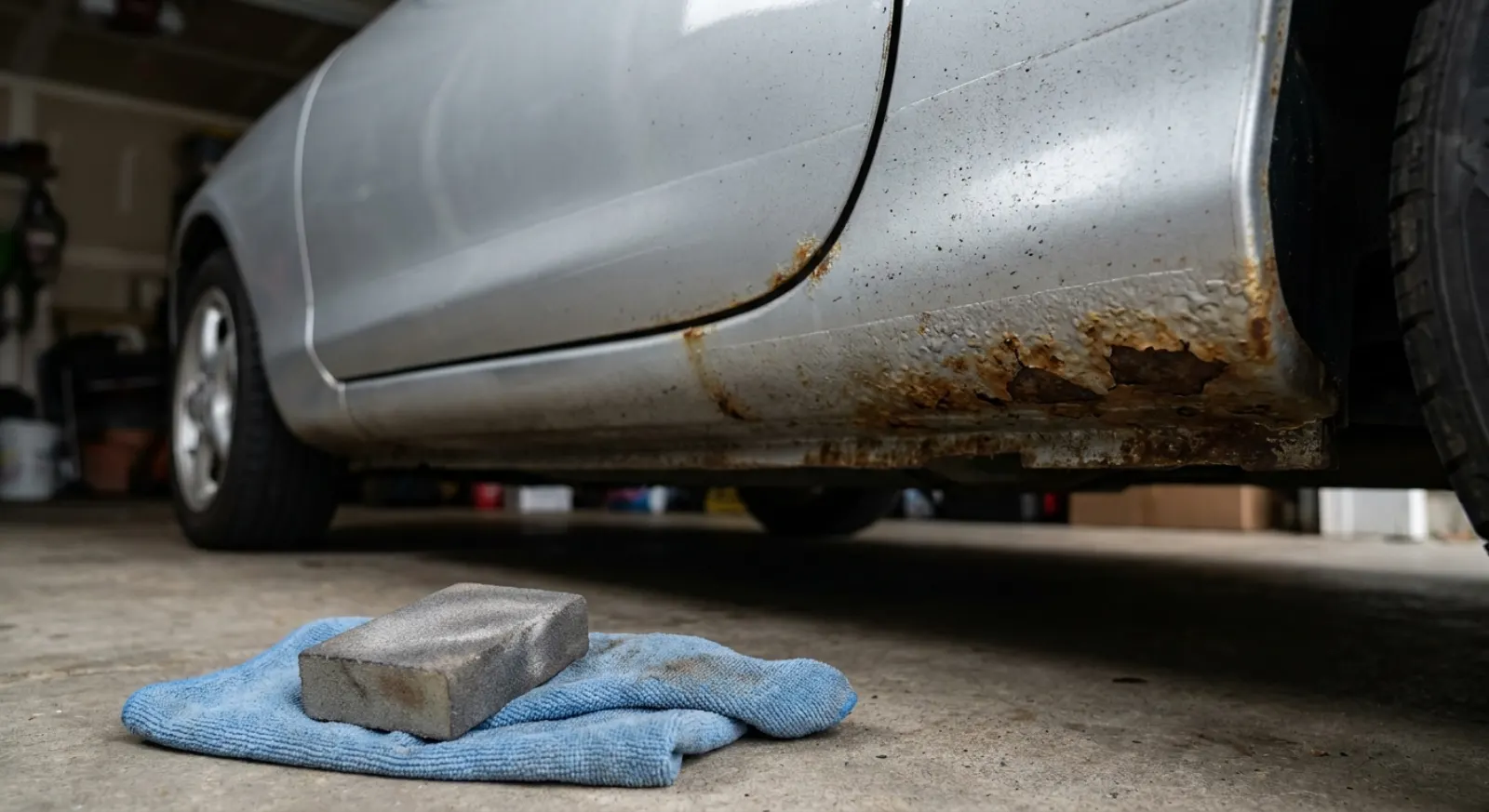
  1. Surface rust (level 1). Orange or brown discoloration sitting on top of the steel where a paint chip exposed bare metal. The rust has not yet eaten into the panel. A fingernail does not catch on a pit. The fix is mechanical removal (sand or wire-brush the rust off, neutralize with phosphoric acid converter, prime, color, clear), all of which I do mobile. Per spot DMV cost: $75 to $200, 45 to 90 minutes.
  2. Scale rust under paint (level 2). The paint looks bubbled, lifted, or has small blisters. Underneath, the rust has spread sideways under the clear coat and started to pit the steel below. The fix has to peel the affected paint off, grind the rust pits clean, treat with rust converter, build primer, paint, and clear. Per spot DMV cost: $300 to $700 mobile if the affected area is under a palm and the panel is reachable, otherwise body shop at $700 to $1,400.
  3. Penetrating rust (level 3). The rust has eaten all the way through the panel. You can see daylight through a pinhole, or the panel flexes and crumbles where you press it. This is no longer a mobile fix. The hole has to be cut out, a steel patch fitted and either welded or riveted in (welded is structural-grade, riveted plus seam sealer is acceptable on non-load panels), then ground flush, filled, primed, painted, and cleared. Body shop cost in the DMV: $700 to $2,000 depending on hole size and panel.
  4. Structural rust (level 4). The rust is on a frame rail, rocker reinforcement, sub-frame, suspension mount, or floor pan and the panel is no longer carrying load. This is a safety issue, not a cosmetic one. Fix requires cutting the affected section out and welding in a patch panel cut to the exact factory profile. Body shop cost: $1,500 to $4,500. On cars over 10 years old with structural rust, the honest answer is sometimes that the car is no longer worth the repair against its market value.

The level matters more than the diameter. A 4-inch surface rust spot is a $300 mobile job. A 1-inch hole through the rocker panel is a $1,200 body shop job. Customers usually expect the math to scale with size, and it does not. It scales with depth.

Surface rust repair cost: rocker panels, wheel arches, chips that started to rust

Surface rust is where the cheap fix lives. I do this work mobile across the DMV every week, usually at level 1 spots on the front bumper, hood, lower doors, and wheel arches. The pricing math is per-spot for the first 1 to 2 spots, then a small per-spot discount kicks in on a cluster job. A single quarter-sized surface rust spot caught at the chip stage is $75 to $150 in your driveway, 45 to 75 minutes. The fix sequence is: mask the area, sand or wire-brush down to bare clean steel, apply phosphoric acid rust converter, let it neutralize, prime with epoxy primer, color-match the factory paint code, spray base coat, spray clear coat, and let it flash before unmasking. Done correctly the spot is invisible at 6 feet and color-matched to the factory paint code at the panel.

Wheel arches and rocker panels are the second most common surface rust spot on DMV cars because they take the most salt spray off the road. A typical lower-rocker rust spot on a 7 to 12 year old Honda, Toyota, or Ford runs $200 to $450 mobile if it is still pure surface (no bubbling, no lifting), 90 minutes to 2 hours. If the rust has started to bubble the paint outward (level 2 territory), the same panel area runs $500 to $900 because the affected paint has to come off and the cleaned area has to be feathered and re-cleared larger than the rust footprint to blend cleanly.

Surface rust on chips with rust started is the cheapest fix on the whole price list because the rust is still tiny. A typical front bumper or hood with 3 to 6 chips that have started to brown costs $150 to $350 for the cluster, all done in one mobile visit of 90 minutes to 3 hours. The annual rust-prevention visit (catch the new chips before the rust spreads) is one of the highest-ROI maintenance items on a DMV daily driver. For the chip-only side of this math see paint chip repair cost.

Scale rust repair cost: when the paint has already started to lift

Scale rust is the level where mobile work is still possible but the price climbs and the time doubles. You can spot scale rust by the small bubble pattern under the paint, by clear coat that has lifted at the edges of a chip into a small flake, or by a circular rust shadow that is larger than the original chip and growing. Underneath, the rust has spread sideways under the paint and is pitting the steel.

The fix is sequence-strict: peel the affected paint and clear off the area (mechanical scraper plus a careful sanding pass, sometimes a low-heat lift), grind the rust pits clean down to bright steel (a rotary sander on a flexible disk), feather the surrounding paint edges into a smooth taper so the new paint can blend, apply phosphoric acid rust converter, let it dry, fill any deep pits with body filler or all-metal filler if the pits are deep enough to show under finish paint, sand the filler flush, epoxy primer, color, clear. Mobile DMV cost on a palm-sized scale rust spot: $300 to $700, 2 to 4 hours.

Once scale rust is larger than a palm, the price math flips: rather than blending into the surrounding paint, the honest fix becomes a whole-panel respray because the feather-blend gets too wide to be invisible. At that point the job moves to a body shop for booth conditions, and the price runs $1,000 to $1,800 per panel depending on color match difficulty. Luxury paint codes (Tesla PPSW Pearl White Multi-Coat, Audi Nardo Grey, Porsche Crayon, BMW Frozen series, Mercedes Designo) add $300 to $700 because the color requires more layers and tri-coat blending. For the paint-code-and-respray math see also car scratch repair cost.

Penetrating rust repair cost: the hole-or-no-hole question

Penetrating rust is where mobile work stops being honest and the fix has to go to a body shop. The diagnostic is simple: press the suspected rust spot firmly with a thumb or a screwdriver handle. If the metal flexes or you push through to daylight, the panel is gone in that spot and a patch is the only fix. Common DMV locations for penetrating rust: rocker panels behind the front wheel arch (salt splash zone), lower fenders on older trucks, rear wheel arches on sedans where the inner liner trapped moisture, and the lower seam of the trunk lid on cars that have leaked seal water for years.

The body shop fix for a 1 to 2 inch hole through the rocker panel runs $700 to $1,400 in the DMV. The shop cuts the rusted section out a clean inch past the damaged metal, fits a steel patch (either factory replacement panel section or a hand-formed piece of 18 to 20 gauge cold-rolled steel) to the exact contour, welds or rivets it in (welded is the right call on visible body panels, rivets-and-seam-sealer is acceptable on hidden inner panels), grinds the welds flush, applies body filler if needed, primes, paints, and clears. A 2 to 3 inch hole goes to $900 to $2,000 depending on whether the patch can use a flat section or has to follow a body line.

The decision math: penetrating rust on a daily driver under 10 years old or worth over $8,000 is almost always worth the $1,200 fix. Penetrating rust on a 14-year-old car worth $4,000 is a tougher call. If the rest of the body is clean and the mechanicals are healthy, the patch is a fair investment. If the rest of the body is also rusting (which is usually the case when one penetrating spot has shown up), the honest answer is to drive it as is until something else fails and replace then. I tell customers the truth on this even when it costs me the job.

Structural rust repair cost: when the panel is no longer worth fixing

Structural rust is the level where the answer is sometimes "this car is done." Frame rails, rocker reinforcement bars, sub-frame mounts, strut towers, floor pans, and inner door pillars are load-bearing parts of the body. Rust through any of these is a Virginia safety-inspection failure and a real crash-safety concern. Fix requires a body shop with frame-jig capability, structural welding certification, and at minimum 2 to 5 full work days. DMV body shop cost: $1,500 to $4,500 depending on which structural member is affected and how much fabrication the patch requires.

The trigger to walk away from the repair is when the structural rust repair cost approaches the car's market value. A $2,200 frame-rail repair on a 15-year-old sedan worth $3,800 is rarely worth it. The same repair on an 8-year-old truck worth $22,000 is a clear yes. The honest rule: if the repair is more than 35 to 40 percent of the car's market value, take the insurance settlement or sell as-is and put the money toward the next car. I keep a relationship with two DMV body shops I trust for structural work and I refer customers to them when the rust is at this level. I do not pad the referral, and I tell customers when the math says walk away.

The 3-question test I run before quoting any rust job

Before I price a rust spot in your driveway, I run the same three questions in the same order. They take 60 seconds and they decide mobile fix, body shop fix, or walk-away without guessing.

Question one: does the metal flex when you press it? Press the rust spot firmly with a thumb. If the metal feels solid and does not move, the rust is still surface or scale and mobile work is in play. If the metal flexes inward and back, or you can hear a slight crunch of rust flakes inside the panel, the rust has gone penetrating and the fix is body shop only.

Question two: is the rust local or is the whole panel going? Look 6 inches in every direction around the visible rust. If the rest of the panel is clean factory paint with intact clear coat, the fix is a local repair and the price holds at the per-spot rate. If you see additional small bubbles, lifting paint, or rust shadows spreading along the lower edge of the panel, the rust is no longer local. The honest fix is then a full-panel respray or a panel replacement, not a spot repair, and the price moves to body shop tier.

Question three: is it a body panel or a structural part? Doors, fenders, hoods, trunk lids, and quarter panels are cosmetic body panels. Rust on these is annoying but not dangerous, and the fix is purely about value preservation. Rust on a frame rail, rocker reinforcement, strut tower, or floor pan is structural and is a safety call before it is a cosmetic call. Structural rust always goes to a body shop with the certification to weld load-bearing patches.

What insurance covers and what comes out of pocket for rust repair

Insurance almost never covers rust repair. Comprehensive coverage covers hail, falling branches, vandalism, animal damage, and other specific incidents. Collision coverage covers accident damage. Neither covers rust because rust is classified as wear-and-tear or owner-maintenance, and every standard auto policy in Virginia, Maryland, and DC excludes it explicitly. The narrow exception is when rust resulted from a covered incident (a dent from a hailstorm cracked the paint and rust started in that spot during the claim wait), and in that case the rust treatment is bundled into the comprehensive claim repair, not paid separately. Even then, the carrier negotiates the rust treatment scope tightly.

Out-of-pocket cost is the entire reality of rust repair. The good news: the cheap fix at level 1 or 2 is small money relative to the resale value preserved. A $200 surface-rust mobile visit on a 6-year-old DMV daily driver typically protects $400 to $900 of resale value at trade-in or private sale. The bad news: by the time rust is at level 3 or 4, the out-of-pocket spend is $1,200 to $4,500 and the resale value protection is roughly the same range, which is why catching rust early is the only honest cost-control move. For the broader insurance-vs-cash-pay decision math on other damage see will insurance cover dent repair.

Real DMV rust jobs I quoted this month

The pricing above is built from work I do every week. Three jobs from the past two weeks across the DMV that show the level-pick in action:

Old Town Alexandria, 2018 Honda Pilot, Modern Steel Metallic. Customer noticed orange spots starting at three rock chips on the front bumper and a small bubble forming on the driver-side rocker panel just behind the front wheel arch. Bumper rust was level 1 surface only. Rocker rust was early level 2 (bubble just starting, no flex). All four spots done in one mobile visit at her driveway. Total: $320, 2.5 hours. Honda dealer service had quoted $1,400 for full rocker respray and bumper paint.

Falls Church, 2014 Ford F-150 XLT. Truck had penetrating rust through both rear wheel arches with a clear 1.5-inch hole on the driver side. Pressed the metal and the entire surrounding area crunched. Level 3, both sides. Referred to my body shop partner in Springfield. Quote came back at $1,650 for both wheel arches patched, welded, primed, and resprayed. Customer chose to do it because the truck still has Carfax-clean drivetrain history and 80,000 miles, and the truck market in the DMV held it at $24,000 even with the rust visible. Would have been a walk-away on a $7,000 truck.

McLean, 2019 Tesla Model 3, Pearl White Multi-Coat. Customer noticed a 1-inch bubble forming on the lower edge of the rear passenger door, six inches above the rocker. Level 2 scale rust, paint lifted, but rust footprint still smaller than a palm. PPSW Pearl White is a tri-coat paint code that needs careful blending. Quoted $580 mobile (90 minutes) for the spot repair against the Tesla service center quote of $1,950 for full door respray. Customer chose mobile because the PPSW blend would otherwise have run $400 to $600 above standard paint at the body shop. For the Tesla-specific paint and panel math see Tesla dent repair and for the aluminum-and-luxury-paint context see aluminum body panel PDR.

FAQs about car rust repair cost

How much does it cost to fix a small rust spot on a car?

A single surface rust spot under 1 inch caught at the chip stage runs $75 to $200 mobile in the DMV. A cluster of 3 to 6 small rust spots on the front bumper and hood runs $200 to $400 in one visit. Mobile pricing assumes the rust is still surface (level 1) and the metal does not flex when pressed. Scale rust under paint runs $300 to $700 per spot.

Is it worth fixing rust on a 10-year-old car?

It depends on what level the rust has reached and what the car is worth. Level 1 surface rust on a 10-year-old daily driver: yes, almost always, because a $200 mobile fix protects $400 to $900 of resale value. Level 3 penetrating rust on the same car worth $5,000: usually no, because a $1,200 patch is 24 percent of the car's value. Level 4 structural rust: walk away if the repair is over 35 to 40 percent of the car's market value.

Can rust come back after repair?

Surface and scale rust repaired correctly (full removal, phosphoric acid converter, epoxy primer, paint, clear) does not come back in the same spot for 5 to 10 years if the paint film stays intact. Rust spots that come back early are almost always cases where the technician sanded but did not fully convert the underlying pitted steel, or where the customer kept parking the car in the same wet salt environment without rinsing the underside through winter.

Will my insurance pay for rust repair?

Almost never. Rust is excluded from comprehensive and collision coverage in standard auto policies in Virginia, Maryland, and DC because it is classified as wear-and-tear. The narrow exception is when the rust started from a covered incident (paint cracked from hail or a covered collision and rust began during the claim wait), and in that case the rust treatment is bundled into the original repair, not paid separately.

Can you fix rust at home without welding?

Yes for surface rust (level 1) and small scale rust (early level 2). The fix is mechanical removal, rust converter, primer, paint, clear. ChrisFix has a well-known walkthrough using common shop tools. No for penetrating rust (level 3) or structural rust (level 4) because both require cutting and patching the panel, which needs welding for load-bearing safety and for finish quality on visible panels.

How long does rust repair take?

Mobile surface rust on one spot: 45 to 90 minutes in your driveway. Mobile cluster of 3 to 6 chips with rust started: 90 minutes to 3 hours in one visit. Mobile scale rust on a wheel arch: 2 to 4 hours. Body shop penetrating rust patch: half day to one full work day. Body shop structural rust patch: 2 to 5 full work days because of welding, fitting, paint, and cure time.

Why do DMV cars rust faster than cars in other states?

Four factors stack: winter road salt brine on I-66, I-95, I-395, the GW Parkway, and the Beltway sits on rocker panels and wheel arches for days; summer humidity at 65 to 80 percent keeps any paint break wet; spring pollen and tree sap etch the clear coat; and salt spray near the Potomac affects cars parked in Old Town Alexandria and Hains Point. The combined corrosion rate on a DMV car runs roughly 3 to 4 times a dry-climate state.

Should I undercoat my car to prevent rust?

Annual undercoating on a DMV daily driver is worth it for cars under 7 years old that you plan to keep. Cost runs $150 to $300 mobile for a clean undercoat reapplication, $250 to $500 at a shop. The honest math: undercoating cuts rust risk by 40 to 60 percent on the underside, which is the salt-splash zone where most structural rust starts. It does not help with paint chip rust on the visible panels, which is a separate maintenance item.

Get an honest rust repair quote in 30 minutes

If you have a rust spot and want a real price before you commit, send three photos: one straight-on of the spot from 2 feet, one close-up showing whether the paint is lifted or bubbled, and one of the area 6 inches around the spot so I can see if rust is spreading or staying local. With those three photos I can tell you within 30 minutes whether it is a $150 mobile fix, a $500 mobile fix, a $1,200 body shop fix, or a walk-away. Mobile body and paint comes to you across Alexandria, Arlington, Fairfax, Falls Church, and McLean. For structural rust I refer to two DMV body shops I trust, and I tell you when the math says the repair is not worth it on the car you have.

Buster has been doing mobile paintless dent repair and auto body and paint work across the DMV for 20+ years. He pulls dents and repairs surface and scale rust at your driveway. No body shop, no repaint of full panels, factory finish stays where it can. Most jobs done in 1 to 3 hours.

Got a dent? Get a free quote.

Text a photo to (703) 975-9626. We respond in minutes.

Call NowFree Estimate