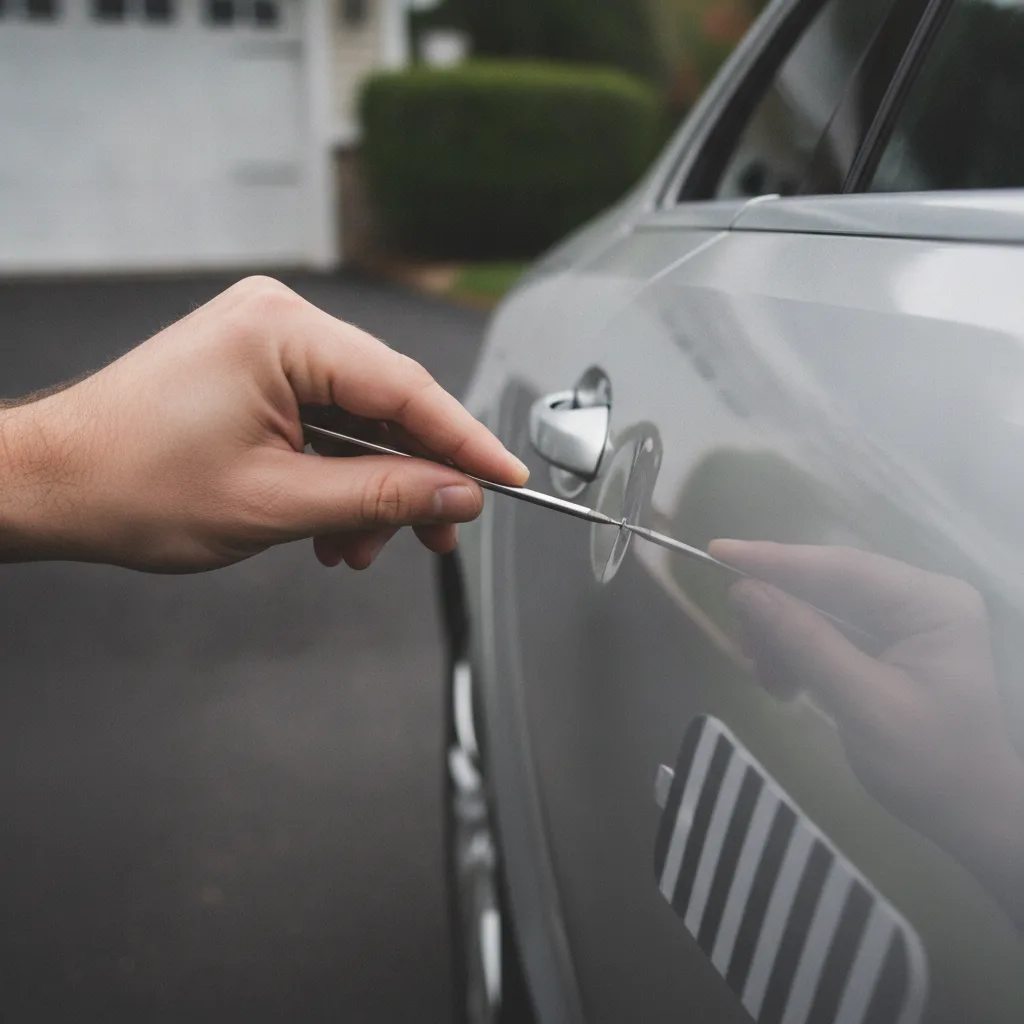

Short version: Most Mercedes and Audi dents are a paintless dent repair job, not a body shop job. If the factory paint is unbroken, a door ding, a shallow crease, or a hail-dented hood pulls back to shape in your driveway with no repaint. Two things make these cars different. A lot of the outer panels are aluminum, which takes longer to pull. And the special-order finishes cannot be spot sprayed to an invisible match, so leaving the paint alone is the only clean fix. In the DMV that is about $120 to $200 for a single door ding, $250 to $500 for a crease, and $500 to $1,500 for a hail-covered hood, mobile, at your driveway. Here is what I can pull on these cars and what I cannot.
Can paintless dent repair fix a Mercedes or Audi dent?
Yes. Most door dings, shallow creases, and hail dents on a Mercedes or an Audi pull clean with PDR, as long as the factory paint is not broken.
The rule that decides it is the same on a C-Class as on a Civic. If the paint is unbroken and the metal has not stretched past its limit, I work the dent from behind the panel back to factory shape. Nothing gets sanded, filled, or sprayed. That covers the calls I get most on these cars: the car next to you opened its door into your rear quarter, a cart rolled into a fender at Tysons, a hail cell caught the hood. What changes on a Mercedes or an Audi is not whether PDR works. It is how long the panel takes, and how much you lose if somebody paints it instead. The general version of that tradeoff is in PDR vs a body shop.
What the Mercedes First Class dent plan actually excludes
The factory plan covers small dings with no deductible and no claim limit, but it excludes dents over four inches, hail damage, and any roof panel with a sunroof.
Mercedes-Benz Financial Services sells a product called First Class Paintless Dent Repair, usually offered once, at the finance desk, when you buy or lease. The generous half is real: no deductible, no mileage limit, no cap on how many times you claim. The part that surprises people is the exclusion list. Per Mercedes-Benz USA's own plan page, it does not cover dents larger than four inches in diameter, hail damage, a roof panel with a sunroof, vandalism, repairs that would damage the paint, or any dent the paintless process cannot fix. Hail is out, and hail is the damage that actually costs four figures around here in the spring. Sunroof roofs are out, and most of these cars have a sunroof.
Mercedes does not publish one national price for it, and it varies by dealer, state, and term. Mercedes-Benz of Marion's page lists $520 to $640 depending on term and model, which is one dealer, not a national rate. So do your own math instead of taking the finance manager's. At DMV mobile rates a single door ding runs about $120 to $200 cash. One ding every couple of years and the plan does not pay for itself. Park in a tight Ballston garage and collect one a season and it might. Audi has no equivalent national plan, so Audi owners are quoted whatever the individual dealer's add-on package includes. Either way, the hail exclusion is the one to plan around, and the real numbers for that are in hail damage repair cost.
Which Mercedes and Audi panels are aluminum
Both brands use aluminum for hoods, doors, fenders, and trunk lids on a lot of models. Aluminum work-hardens as it is pulled, so in my experience the same dent takes 25 to 50 percent longer.
This is the fact that changes the job, and I could not find it published anywhere for either brand in one place. Here is what the manufacturers' own body-repair material covers. Where I could not find a manufacturer source for a model, I left it off. Pulled from Audi's Body and Collision self-study program and from Mercedes' published body-structure announcements.
| Model | Outer panels commonly aluminum | What it means for the pull |
|---|---|---|
| Mercedes S-Class (2021 on) | Roof, hood, fenders, trunk lid, doors | Nearly the whole skin. Specialist job, add time |
| Mercedes C-Class | Front fenders, hood, doors, trunk lid | Most common panels are aluminum. Plan for it |
| Mercedes G-Class (2019 on) | Hood, doors, fenders | Steel body, aluminum skin panels |
| Mercedes A-Class | Hood, front fenders | Doors usually steel. Faster than a C-Class |
| Audi A6 and A7 | Front fenders, hood, doors, trunk lid | Same read as the C-Class |
| Audi Q7 (2017 on) | Hood, fenders, tailgate, roof, doors | Heavy aluminum use. Longest of the SUVs |
| Audi TT | Most of the outer skin | Aluminum throughout |
| Audi A4 | Trunk lid only, skin is mostly steel | Standard steel timing on doors and fenders |
Check your own year and trim before taking that as gospel. Manufacturers change panel material mid-generation. Mercedes moved the 2021 S-Class to more than 50 percent aluminum in a single model change, which is exactly the jump that catches a tech out. Why it matters: steel has memory and wants to go back. Aluminum does not. It hardens as you move it, so it fights you, needs gentle heat and more passes, and cracks paint if somebody rushes it. That is not a reason to avoid PDR on these cars. It is a reason to ask whether your tech has pulled aluminum before. The full mechanism is in why aluminum panels need a specialist.
Matte and special-order paint: why PDR is the only finish-safe fix
MANUFAKTUR magno matte and Audi exclusive colors cannot be polished or spot sprayed to an invisible match. PDR never touches the paint, so it is the only fix that keeps the finish correct.
Mercedes sells its matte finishes under the magno name, through the MANUFAKTUR program that used to be called designo. Matte paint is a flat clear coat. You cannot wax it, buff it, or polish out a blend edge, because every one of those puts gloss into a finish that is supposed to have none. A body shop cannot spot-repair matte and hide it. The honest fix on matte is a whole panel, sprayed by a shop that does matte regularly, and it is expensive.
Audi's version is the exclusive program, low-volume mixes ordered per car. Nardo Grey catches people out for a different reason. It is a solid non-metallic grey with no flake to hide behind, so a blend edge shows in flat daylight the way it never would on a silver metallic. Either way the conclusion is the one every used-car appraiser here will confirm: they run a paint meter over the panels before they price the car, a repainted panel reads different from factory, and the car gets logged as having body work. On a lease return that stacks with the wear-and-tear charge, and the math is in lease return dent repair prep. Same argument as BMW dent repair and Tesla dent repair.
The Mercedes and Audi dents I cannot pull
Torn or cracked paint, a sharp crease sitting on a body line, and metal stretched past its limit all need paint work, not PDR.
I tell you straight when a dent is past me, because pushing it anyway cracks the paint and then you own a bigger problem. Three go to a body shop. Any dent where the paint is already split or gouged down to primer. A deep impact that stretched the metal so far it will not hold shape without filler. And the one specific to these cars, a sharp crease landing directly on a body line. Mercedes and Audi both run hard character lines down the doors, and metal on a fold is stiffer and less forgiving than metal on a flat panel. A shallow dent touching a body line is often still workable and just takes longer. A sharp one that cracked the clear coat along the crease is not. The video above is a tech doing exactly that job on a Mercedes body line, and it is a fair picture of how slow it has to be. The full list of what pulls and what does not is in which dents PDR can fix.
What Mercedes and Audi dent repair costs in the DMV
Mobile PDR runs about $120 to $200 for a single ding, $250 to $500 for a crease, and $500 to $1,500 for a hail-covered hood or roof. The same damage written up at a dealer collision center is usually four figures.
The left column is my own cash-pay mobile pricing for cars with intact factory paint. The right column is what customers have told me they were quoted at a dealer collision desk for the same damage. Treat that side as the range I hear, not a published rate.
| Damage | Mobile PDR (DMV) | What customers tell me the dealer quoted | Mobile time |
|---|---|---|---|
| Single door ding, shallow, paint intact | $120 to $200 | $800 to $1,300 plus shop fee | 45 to 60 min |
| Door or fender crease, paint intact | $250 to $500 | $1,200 to $1,800 plus shop fee | 1 to 2 hours |
| Hood or roof hail cluster, factory paint | $500 to $1,500 | $2,500 to $6,000 | Half to full day |
| Aluminum panel (S-Class, A6, A7, Q7) | Add 25 to 50 percent | Add aluminum labor premium | Add 15 to 45 min |
| Magno matte or Audi exclusive, dent only | Same PDR price, paint stays | Add $400 to $900 for finish match | Same |
| Torn or cracked paint (not a PDR job) | Not a PDR job | $900 to $2,500 respray | Body shop, days |
Compare that first row to the $500 to $1,000 per incident a dealer page quotes when it is selling you the protection plan. That number is not made up. It is just a dealer-body-rate price for the same dent I pull for $150 in a driveway. The full per-size breakdown across all cars is in how much paintless dent repair costs.
The German luxury dents I see most around Northern Virginia
McLean, Great Falls, Tysons, and Arlington are where I see most of these cars, and the damage follows the parking.
Tight condo and office garages in Rosslyn, Ballston, and Tysons produce door dings from the car in the next space and mirror creases from a tight pull-through. The lots at Tysons Galleria and Pentagon City produce cart hits on rear doors and quarter panels. In spring a hail cell fills a hood and roof in ten minutes, and on an S-Class or a Q7 that hood is aluminum, so it is a longer day. Almost all of it is intact-paint damage, which is the PDR sweet spot. The call I get most: parked at the Metro for two hours, came back to a ding, no paint damage, can you fix it. Yes, usually that same week, at your house or your office.
How to get an honest Mercedes or Audi dent quote
Send three photos and your paint code. That tells me the panel, whether it is steel or aluminum, and whether the color is a special-order finish.
Take three photos: one straight on, one at a low angle with light raking across the dent so I can read its depth, and one wide enough to show the panel and the body lines. Then find the paint code. On a Mercedes it sits on the data card, usually a sticker inside the driver door jamb or under the hood on the radiator support, and reads as a three-digit number. On an Audi it is most often on a sticker in the trunk under the spare wheel cover. Tell me the year, model, and trim so I know steel or aluminum. With that I can tell you whether it is a PDR job or a paint job, and roughly what it costs, before anyone spends a dime.
Frequently asked questions about Mercedes and Audi dent repair
Does paintless dent repair work on a Mercedes?
Yes. Door dings, shallow creases, and hail dents pull clean as long as the factory paint is unbroken. Many Mercedes panels are aluminum, which adds time, but the method is the same and the paint is never touched.
Is the Mercedes First Class dent repair plan worth it?
It depends on how you park. It has no deductible and no claim limit, but it excludes hail, dents over four inches, and roof panels with a sunroof. A single mobile ding repair runs $120 to $200 cash here. Do that math against the plan price you are quoted.
Can you fix a dent on an aluminum Audi panel?
Yes, if the paint is intact. Aluminum work-hardens as it is pulled, so it needs gentle heat, more passes, and 25 to 50 percent more time than steel. It is a specialist repair, not a quick pull, but the factory finish stays untouched.
Will PDR damage Mercedes magno matte or Audi exclusive paint?
No. PDR works the metal from behind the panel and never touches the finish. That is exactly why it is the right call on matte and special-order colors, which cannot be polished or spot sprayed to an invisible match.
How much does Mercedes dent repair cost in the DMV?
A single door ding with good paint runs about $120 to $200 mobile, a crease $250 to $500, and a hail hood or roof $500 to $1,500. Aluminum panels add 25 to 50 percent. The same dents at a dealer collision center are usually four figures.
Does a repaired dent hurt Mercedes or Audi resale value?
A PDR repair does not, because nothing about the paint changes. A repaint does. Appraisers run a paint meter over the panels, a sprayed panel reads different from factory, and the car gets logged as having body work.
How long does Mercedes or Audi dent repair take?
Most dings and creases with good paint take 45 minutes to two hours at your home or office. A hail-covered hood or roof can run half a day to a full day. Aluminum panels add time. You never lose the car to a shop for a week.
Buster has been doing mobile paintless dent repair and auto body and paint work across the DMV for 20+ years. He pulls dents at your driveway. No body shop, no repaint, factory finish stays. Most jobs done in 1 to 2 hours.