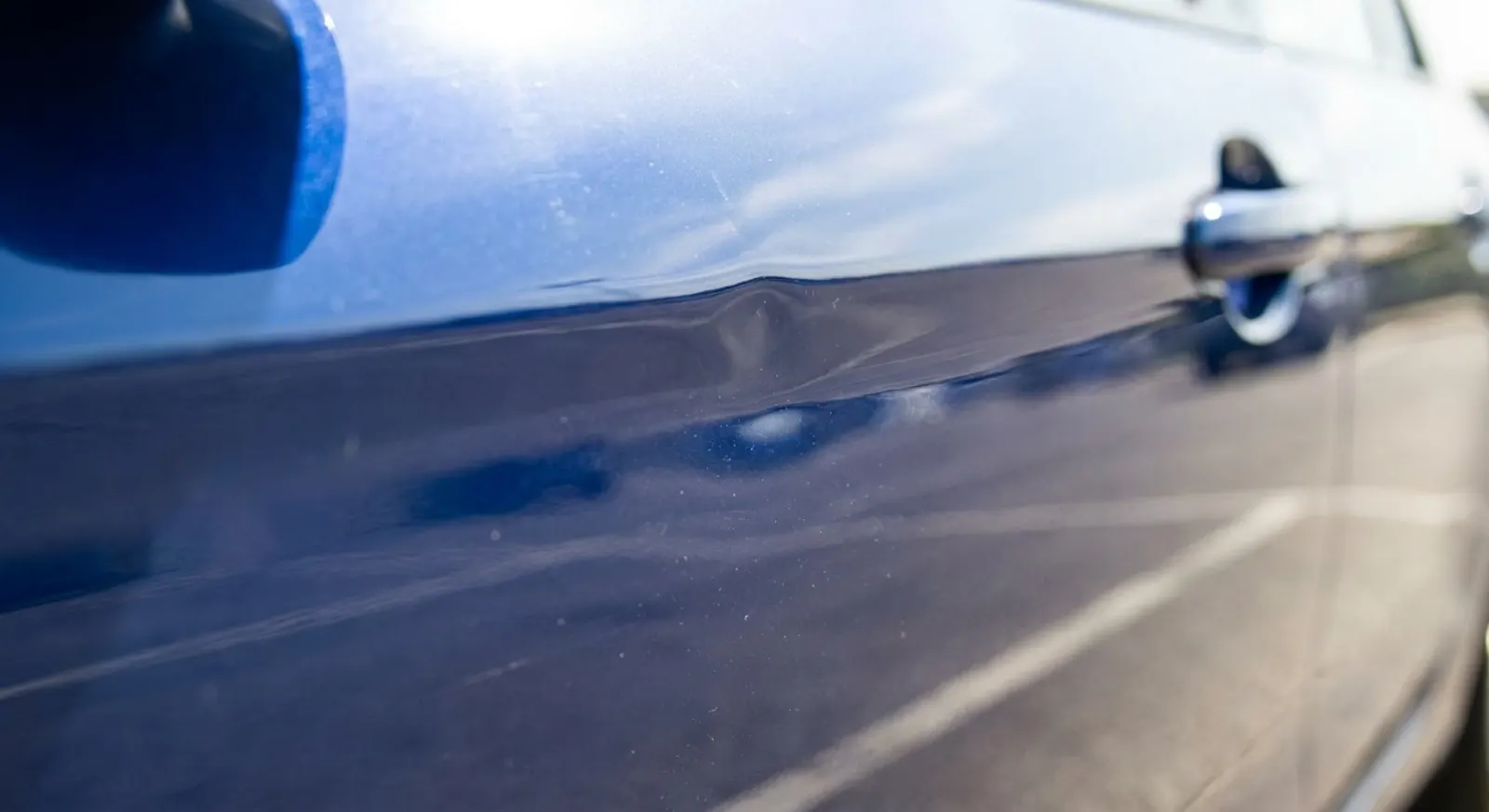
Short version: Mobile car door dent repair in the DMV runs $75 to $800 in most cases, depending on dent size, where the dent sits on the door, whether the paint is broken, and whether the door skin is steel or aluminum. A small round dent on the flat of the lower panel is $75 to $200. A belt-line crease across the middle of the door is $400 to $700. An edge dent near the door handle is $300 to $600 because access is harder. A deep door dent with paint torn is $400 to $800 with PDR plus touch-up. Aluminum door panels (Tesla Model 3 and Y front doors, Ford F-150 fronts, late Lexus) run 25 to 50 percent above the steel ranges. Body shop quotes on the same damage start at $600 and push past $1,800 because they default to door-skin removal and full panel respray. After 20+ years pulling dents out of car doors in Alexandria, Arlington, Fairfax, Falls Church, and McLean driveways, here is the real math by dent type, by door zone, and the three photos I need to give you an honest quote in under 30 minutes.
How much does car door dent repair cost in the DMV in 2026
Mobile car door dent repair at my DMV rate runs $75 to $800 for almost every job that stays in PDR territory. The price moves on five things: how big the dent is across, how deep it pushes into the panel, where it sits on the door (lower flat, upper flat, belt-line crease, or near the handle and latch edge), whether the paint is intact or torn, and whether the door skin is steel or aluminum. Body shop estimates on the same damage start at $600 just for door-skin labor and paint, and push past $1,500 if they decide to replace the door skin or pull the door card to access the bracket behind the dent. The table below is what I actually charge in your driveway across the DMV, against what the shops up the road quote for the same job.
| Door dent type | Mobile repair (DMV) | Body shop quote | Time |
|---|---|---|---|
| Small round dent, lower panel, paint intact | $75 to $200 | $400 to $700 (respray) | 30 to 60 min |
| Round dent 3 to 5 inches, mid panel, paint intact | $150 to $350 | $600 to $1,000 | 60 to 90 min |
| Larger round dent 5 to 8 inches | $250 to $500 | $800 to $1,400 | 90 min to 2 hours |
| Belt-line crease across mid-door | $400 to $700 | $1,100 to $1,800 | 2 to 4 hours |
| Edge dent near door handle or latch | $300 to $600 | $900 to $1,500 | 90 min to 3 hours |
| Upper-door dent above belt-line | $200 to $500 | $700 to $1,300 | 90 min to 2 hours |
| Deep dent with paint torn (PDR + touch-up) | $400 to $800 | $1,200 to $1,800 | 2 to 4 hours |
| Aluminum door skin (Tesla, F-150, Lexus) | Add 25 to 50 percent to steel ranges | Add 30 to 60 percent | Add 30 to 60 min |
| Door shell bent, gaps off-square | Not a mobile job alone | $1,500 to $3,500 | Body shop, frame work |
These ranges are for single-door damage where the door still latches, the window still rolls up and down, the gaps to the front fender and rear quarter are still square, and the door card on the inside is intact. If the door does not latch, the window binds, the gap visibly widens at one end, or the door card is cracked from the inside hit, the math changes. For per-size pricing across all dents see how much does paintless dent repair cost, and for the small-ding side specifically see door ding repair cost.
Why car doors dent differently than other panels
Car doors are the most-dented panel on the average DMV car, and they dent in patterns that other panels do not. Three structural reasons. First, the door skin is thinner-gauge sheet metal than the fender or quarter panel because the door has to be light enough to swing on hinges without sagging over 10 years. Thinner metal dents at lower impact energy. Second, the door sits at the height where shopping cart corners, other car doors, kids on bikes, bumpers in tight parking spots, and grocery bag loads all land. The damage zone is exactly where contact happens. Third, the door has a structural beam running horizontally inside (the intrusion beam, required by federal side-impact standards since 1973). That beam is the belt-line you can see and feel from outside, and dents around it work differently from dents anywhere else on the car.
The intrusion beam splits the door panel into three zones that price out differently. The lower panel sits below the beam, the upper panel above it, and the belt-line itself runs across the middle horizontally. A round dent in either flat zone is straightforward PDR work because the metal flexes against the inside of the door cavity and pushes back to shape from inside. A crease that crosses the belt-line has the intrusion beam directly behind it, which means less working space and longer dwell time, and the price reflects that. Edge dents near the handle or the latch face the same access problem from the other direction, with the latch mechanism and the lock rod sitting behind the dent.
The other thing that makes door dents distinct: doors hold electronics. The window regulator motor, the speakers, the door switch panel, the wiring harness, and on newer cars the electronic latch and the side-impact sensor all live inside the door cavity. A hit hard enough to dent the door skin can also nick the window regulator track or pinch a wiring run. About 1 in 20 DMV door-dent jobs I price has secondary damage to something inside the door, which is why I check window function before quoting.
The 5 main types of car door dents and what each costs
After two decades doing mobile work, five dent patterns make up roughly 90 percent of door-dent calls. Knowing which pattern you have puts you within $100 of an honest quote before anyone shows up.
- Door ding from another car door or shopping cart. Small round mark, 1 to 2 inches across, on the lower or middle panel, paint intact. Real DMV mobile price: $75 to $150, 30 to 45 minutes on-site. The bread-and-butter door dent. Body shop quotes $400 to $700 for "respray the door" on the same damage.
- Round dent from a hard hit (bumper at slow speed, motorcycle handlebar, runaway grocery cart loaded heavy). 3 to 5 inches across, deeper than a ding, sometimes with a small paint break in the center. Real DMV mobile price: $150 to $400, 60 to 90 minutes. Body shop: $600 to $1,200.
- Belt-line crease. Horizontal sweep across the middle of the door where the intrusion beam sits behind the skin. Common cause: side-swiped while parked, low-speed slide against a guardrail, or a hard impact from another car's bumper at door height. Real DMV mobile price: $400 to $700, 2 to 4 hours. Body shop: $1,100 to $1,800.
- Edge dent near the door handle or latch. Dent within 4 inches of either edge of the door, where the door mechanism sits behind the panel. Common cause: someone leaning a bike against the door, a handle yank that hit a hard object, or a hit from a car door swung open at edge-of-panel height. Real DMV mobile price: $300 to $600, 90 minutes to 3 hours. Access is the cost driver, not depth.
- Deep dent with paint torn. Any of the above patterns where the paint is broken to primer or bare metal. The metal pull is the same, but the job adds a factory-color touch-up and clear-coat blend. Real DMV mobile price: $400 to $800 depending on dent size and paint code. Body shop: $1,200 to $1,800. For the touch-up math by paint depth see paint chip repair cost.
For the small ding subset specifically see door ding repair cost, which covers the under-$200 end of the spectrum in more detail. For the full dent diagnostic glossary across all panels see types of car dents.
Where the dent sits on the door changes the price
The biggest single price-mover on a door dent (after paint break) is where on the door the dent sits. Three zones, three different pricing realities.
Lower panel below the belt-line. Easiest access from inside the door cavity. PDR rods reach the back of the dent cleanly, the working angle is comfortable, and the metal pushes back to factory shape without fighting structure. Cheapest zone. A 4-inch round dent here is $200 to $350 mobile.
Upper panel above the belt-line. Slightly harder because the window glass and the regulator track sit inside. Window has to be rolled all the way up or all the way down for clean access, and the rod path is narrower. A 4-inch round dent here is $250 to $450 mobile. Same dent, $50 to $100 more than the lower-panel version because of access.
Belt-line itself. The intrusion beam runs directly behind it. Working a dent that crosses the belt-line means going at it from both sides of the beam in alternating passes, which doubles the dwell time. A horizontal sweep crease across the belt-line is $400 to $700 mobile, regardless of whether the dent looks shallow or deep on the surface. Belt-line creases are the most underestimated job in DMV door dents.
The fourth zone, the edges, is its own discussion below.
Front door vs back door: why access affects the labor
Same dent, same size, same depth, same paint break, on the front door versus the back door of the same car can price out $50 to $150 apart in either direction. Two reasons.
Front doors hold more hardware. The window regulator is larger, the speaker is usually 6 by 9 inches with magnet and wiring, the door switch panel runs every electric function (windows, locks, mirrors, on some cars the trunk release), and the side mirror wiring runs through the front edge. On luxury and newer cars, the front door also holds the side-impact airbag and the side curtain sensor. More hardware inside means less working space for PDR rods and more careful rod routing. Front door dents on a 2018 to 2025 sedan or SUV typically add 15 to 25 percent labor over the same dent on a back door.
Back doors are usually emptier inside. On most non-luxury sedans and SUVs, the back door has a smaller window, a smaller speaker, no mirror wiring, and a simpler latch. PDR rods have more swing space and the dent pulls cleaner. The exception: SUVs with rear-seat infotainment screens or with motorized rear-window shades have hardware in the back doors that the same year sedan would not have.
On two-door coupes (Mustang, Camaro, Challenger, BMW 2-series, Audi A5, Lexus RC) the doors are longer and heavier than sedan doors, the window regulators are larger to run the longer glass, and the impact frequency on the rear edge near the latch is higher because passengers swing the door wide to exit. Coupe door dents run 10 to 20 percent above the comparable sedan price.
Edge dents near the door handle or latch cost more (access, not depth)
The single category of door dent that surprises DMV customers on the quote is the edge dent. A 2-inch round dent that sits 3 inches from the door handle, or 3 inches from the latch face, costs more than the same dent dead-center on the panel. Not because the metal is harder to pull, but because the hardware behind that area blocks rod access.
Behind the door handle sits the handle mechanism, the linkage rods, and on newer cars the electronic latch motor. Behind the latch face sits the latch assembly itself, plus the lock rod and the door-ajar switch. Behind the rear edge of the door sits the hinge bracket structure. All three areas are full of metal and plastic that a PDR rod cannot route through. The fix is either tighter rod work from outside the hardware zone, or removing the door card to access from a different angle, both of which add labor time.
Real DMV mobile pricing on edge dents: $300 to $600 for what would be a $150 to $300 job dead-center. Sometimes the answer is "do not pull this dent, the access cost exceeds the value." Honest quote, every time.
Mobile car door dent repair vs body shop: the real cost split
Same dent, same paint break, same access. Mobile rate $300, body shop rate $900. The dollar gap is structural, not greed. Body shops default to door-skin process: pull the door card off (1 hour book rate), pull the regulator or wiring out of the way (30 minutes), bondo and sand the dent (1 to 2 hours), prime, paint, clear coat, polish (2 to 3 hours), reinstall (1 hour). Book-rate labor at $130 to $180 per hour plus paint materials puts a routine door dent at $900 to $1,400 dealer quote, $700 to $1,000 independent shop. Plus the car sits at the shop 3 to 5 days.
Mobile car door dent repair pulls the metal from inside the door cavity through existing access points, blends paint only where the topcoat is torn, uses a factory-code color match, and preserves the original factory finish on the rest of the panel. Total dwell time is 1 to 4 hours in your driveway versus 3 to 5 days at the shop. No rental car, no shop schedule, no respraying a half-perfect door.
Where the body shop wins: any job where the door skin must be replaced (rare, only when the door shell is bent and the gaps to fender or quarter are off-square), any job involving the door frame or hinge bracket, any job with wiring damage inside the door that needs harness work, and any insurance claim where the carrier requires direct billing through a shop in their network. The full mobile-versus-shop mechanics live in mobile vs shop paintless dent repair.
Aluminum door panels run 25 to 50 percent above steel pricing
Aluminum door skins are common on Tesla Model 3 and Model Y front doors, late-model Lexus (some IS, ES, LS), Audi A8 and some A7, and a handful of Porsche trims. Ford F-150 fronts went aluminum in 2015 and stayed there. Jaguar full-body aluminum since the XE generation.
Aluminum work-hardens faster than steel during the PDR pull cycle, which means more push cycles to bring the panel back to factory shape without stress-cracking the paint. The labor adjustment is 25 to 50 percent above the steel ranges, depending on dent depth and where the dent sits. A 4-inch round dent on a steel door at $250 mobile becomes $325 to $375 on an aluminum door. A belt-line crease on a steel door at $500 becomes $650 to $750 on an aluminum door.
The other factor on aluminum doors: pricing-protected paint codes. Tesla Pearl White Multi-Coat (PPSW), BMW Frozen finishes, Audi Nardo Grey, and Porsche custom paints sit on aluminum panels often enough that the touch-up math is its own line item. The structural reason aluminum behaves the way it does, plus per-brand patterns, lives in aluminum body panel PDR. For Tesla-specific per-panel work see Tesla dent repair.
When a car door dent is too deep for PDR
Most car door dents are PDR-fixable, but not all. Four signals that push the job out of mobile and into body-shop work.
Stretched metal. A dent so deep that the metal has been pulled past its elastic limit will not push back to factory flat. PDR leaves a visible bulge or a low spot. Industry rule of thumb: dents deeper than 1 inch on a flat panel section, or any dent that shows a stretched look (the metal looks thin or wavy at the deepest point) is body-shop work. Real DMV examples: hit by another car backing out of a parking space at moderate speed, or by a falling object from a truck bed.
Cracked paint that runs deep. Surface paint break is fine for PDR plus touch-up. Paint that has cracked all the way through to bare metal across more than 2 inches of the dent, or paint that has flaked off in chunks, needs primer and respray on the affected area. That moves the job past mobile touch-up into spot-repair-with-paint, sometimes still mobile, sometimes body shop depending on the area.
Door shell bent (not just the skin). The door has two layers: the outer skin (what you see) and the inner shell (the structural cage with the hinge and latch mountings). If the inner shell has bent, the gaps between the door and the front fender or rear quarter widen at one end, the door binds when closing, or the latch does not catch square. Door shell damage is body-shop work, often with door skin replacement.
Hardware damage behind the dent. If the window will not roll smoothly, the speaker rattles, the door handle feels off, or a wiring code triggered after the hit, the dent is the small problem. The hardware damage drives the job to body-shop or dealer service. Mobile PDR cannot replace a damaged window regulator or fix a torn wiring run.
The 3 photos and 1 detail I need to quote your car door dent
Most DMV customers text photos before they call. Three photos and one detail get me to a real number inside of 20 minutes. Photo one: straight-on shot from about 6 feet back, showing the whole door in frame and the dent visible. That tells me where on the door the dent sits (lower, upper, belt-line, edge) and how it relates to the door's intrusion beam and hardware zones. Photo two: angled close-up from 18 inches, with a flashlight or phone light raking across the dent from the side, so the shadows reveal depth and shape. That tells me whether it is a clean round dent that pulls fast or a crease that needs more passes. Photo three: a fingernail close-up at the deepest visible scratch or paint break. Run your fingernail across the deepest part. If your nail catches an edge or a crack, the paint is broken and the math shifts to include touch-up. If your nail glides clean, the paint is intact and most of the cost is the metal pull.
The one detail: year, make, model, trim, and factory paint code if you can find it (look in the door jamb sticker, driver-side door, near the latch). That tells me whether the door skin is steel or aluminum, what hardware sits behind the panel, and whether the color is a pricing-protected paint where matching is a job by itself. The paint code is usually three letters or a three-character alphanumeric on the door jamb sticker, sometimes printed next to a label that says "EXT COLOR" or "PNT".
3 things I check in your driveway before I quote a door dent
When I show up at your house in Old Town, Del Ray, Clarendon, Pentagon City, Tysons, Fair Oaks, Reston, or Falls Church, the in-person quote takes 5 minutes and runs the same three checks.
- Door function. Window rolls up and down smoothly? Door latches square on the first pull? Door opens and closes without binding? Gap between the door and the front fender even from top to bottom? Same gap to the rear quarter? If any of those is off, the door shell has moved and the job is not pure PDR. If all four check clean, the dent is skin-only and PDR is the right tool.
- Paint break depth. Fingernail test in person, then a paint-thickness gauge reading if I have any doubt. A clean glide says factory paint intact, PDR-only fix, no touch-up. A catch says paint torn, touch-up math added. Bare metal showing through means deeper repair, possible respray on the affected area.
- Hardware behind the dent. If the dent sits in the upper panel, I roll the window down and listen for any binding or unusual track noise that suggests the regulator was nicked. If the dent sits near the speaker, I tap the panel and listen for a rattle. If the dent sits near the handle or latch, I work the handle and latch a few times. Hidden hardware damage is the number one reason a mobile quote needs to flag a body-shop referral instead of taking the job.
FAQs about car door dent repair cost in the DMV
How much does it cost to fix a dent on a car door?
Mobile PDR on a car door dent in the DMV runs $75 to $800 depending on dent size, where the dent sits on the door, and whether the paint is broken. A small round dent on the lower panel is $75 to $200. A belt-line crease is $400 to $700. An edge dent near the door handle is $300 to $600. A deep dent with paint torn is $400 to $800 with touch-up. Aluminum door panels add 25 to 50 percent above the steel ranges.
Can a car door dent be fixed without repainting?
Yes for most door dents where the paint is intact. Paintless dent repair pushes the metal back to factory shape from inside the door cavity, the original factory finish stays untouched, and the only material on the panel is what was there from the factory. The exceptions are dents where the paint is cracked or broken (which add a factory-code touch-up), and dents deeper than 1 inch where the metal has stretched past its elastic limit (which need body-shop work).
How long does mobile car door dent repair take?
Most door dents are done in your driveway in 30 minutes to 4 hours. Small round dents on the lower panel are 30 to 60 minutes. Larger or mid-panel dents are 60 to 90 minutes. Belt-line creases are 2 to 4 hours. Edge dents are 90 minutes to 3 hours because access is harder. See how long does paintless dent repair take for the timing breakdown.
Why are car door dents the most common dent type?
Doors sit at exactly the height where shopping cart corners, other car doors, runaway carts loaded with groceries, bicycle handlebars, and other cars' bumpers in tight parking spots land. The door skin is also thinner-gauge metal than the fender or quarter because the door has to swing on hinges without sagging. Thinner metal at impact height makes doors the most-dented panel on the car.
Does where the dent sits on the door change the price?
Yes, by a lot. The lower flat panel is the cheapest because PDR rods access cleanly from inside the door cavity. The upper flat panel adds 15 to 25 percent because the window glass and regulator are in the way. The belt-line crease zone runs $400 to $700 because the intrusion beam sits directly behind it. Edge dents near the handle or latch add $100 to $200 because the hardware blocks rod access.
Will mobile door dent repair affect my factory paint warranty?
No on the PDR side because nothing touches the paint. The metal is pulled from the back, the factory clear coat and base coat stay intact, and the panel still reads as factory finish on a thickness-gauge inspection. On the touch-up side (when the paint is broken), the factory color code is matched, blended at the edge of the damage only, and clear-coated to seal. That repair does not void the factory warranty on the rest of the panel because the surrounding paint is unchanged.
What does a body shop quote for the same door dent cost?
2x to 3x the mobile rate on most door dents. A $200 mobile PDR job becomes a $600 to $900 body-shop quote because the shop process assumes door-skin removal, full panel respray, and book-rate labor at $130 to $180 per hour. A $500 mobile belt-line crease job becomes a $1,200 to $1,800 shop quote for the same reason. Body shop is the right answer only when the door skin must be replaced, the door shell is bent, or hardware inside the door needs work.
Can paintless dent repair fix a crease on the door belt-line?
Usually yes, with more time and labor than a flat-panel dent. The intrusion beam behind the belt-line means the dent has to be worked in alternating passes from both sides of the beam, which doubles the dwell time. Real DMV mobile price on a clean belt-line crease is $400 to $700. The crease has to be sharp and the paint mostly intact for PDR to win. A belt-line crease with extensive paint break or stretched metal is body-shop work.
Are aluminum car doors harder to fix than steel?
Yes, by 25 to 50 percent more labor and time. Aluminum work-hardens faster than steel during the pull cycle, which means more push cycles and slower technique to bring the panel back to factory shape without stress-cracking the paint. Common DMV aluminum-door cars: Tesla Model 3 and Y front doors, Ford F-150 fronts (2015 and up), Lexus IS and ES select years, Audi A8, Porsche select trims, Jaguar full-body aluminum. See aluminum body panel PDR for the structural reason and the per-brand patterns.