
Short version: A cheap DIY dent kit can work, but only on one narrow kind of dent: a shallow, rounded ding with the paint still intact and no sharp crease. The glue-pull tabs are the tools worth owning. Suction cups almost never move real body-panel metal, and the drill-in slide-hammer kits can leave you worse off by damaging your paint. Nothing in a 30-dollar box tapers a high spot or reads a crease the way a trained hand does, which is why so many kits leave a dent that is close but never gone. After 20-plus years fixing dents across Alexandria, Arlington, Fairfax, Falls Church, and McLean, here is the honest breakdown of what these tools actually do, which one to buy, and when to just send me a photo.
Do DIY dent removal kits and dent pullers actually work?
Sometimes, on the right dent. Glue-pull kits can lift a shallow, round dent with intact paint. Creases, sharp dents, and cracked paint are beyond any kit.
Here is the honest answer nobody selling a kit will give you. Yes, a DIY dent puller can work, but only inside a small window. If your dent is shallow, rounded, on a flat and reachable panel, and the paint is not cracked, a glue-pull kit has a real shot at making it noticeably better. That is a door ding from a shopping cart or a car door in a parking lot, the kind of thing I pull all day. But the moment the dent has a sharp crease, a hard edge, cracked or chipped paint, or it sits on a tight body line, no kit is going to fix it, and the wrong one will make it worse. The tool is not the skill. The kit just gives you a way to pull on the metal. Reading the dent, knowing how far to pull, and tapping down the high spots is the actual job. For a full read on which dents come out clean and which do not, see what damage can be fixed without paint and the types of car dents.
The four kinds of DIY dent tools you will find
DIY dent removal breaks down into four tool types: suction cups, glue-pull kits, drill-in slide hammers, and hot-water tricks. Only one is worth your money.
Search for a dent puller and you will hit a wall of products that all promise the same magic. They are really just four different ideas, and they are not equal:
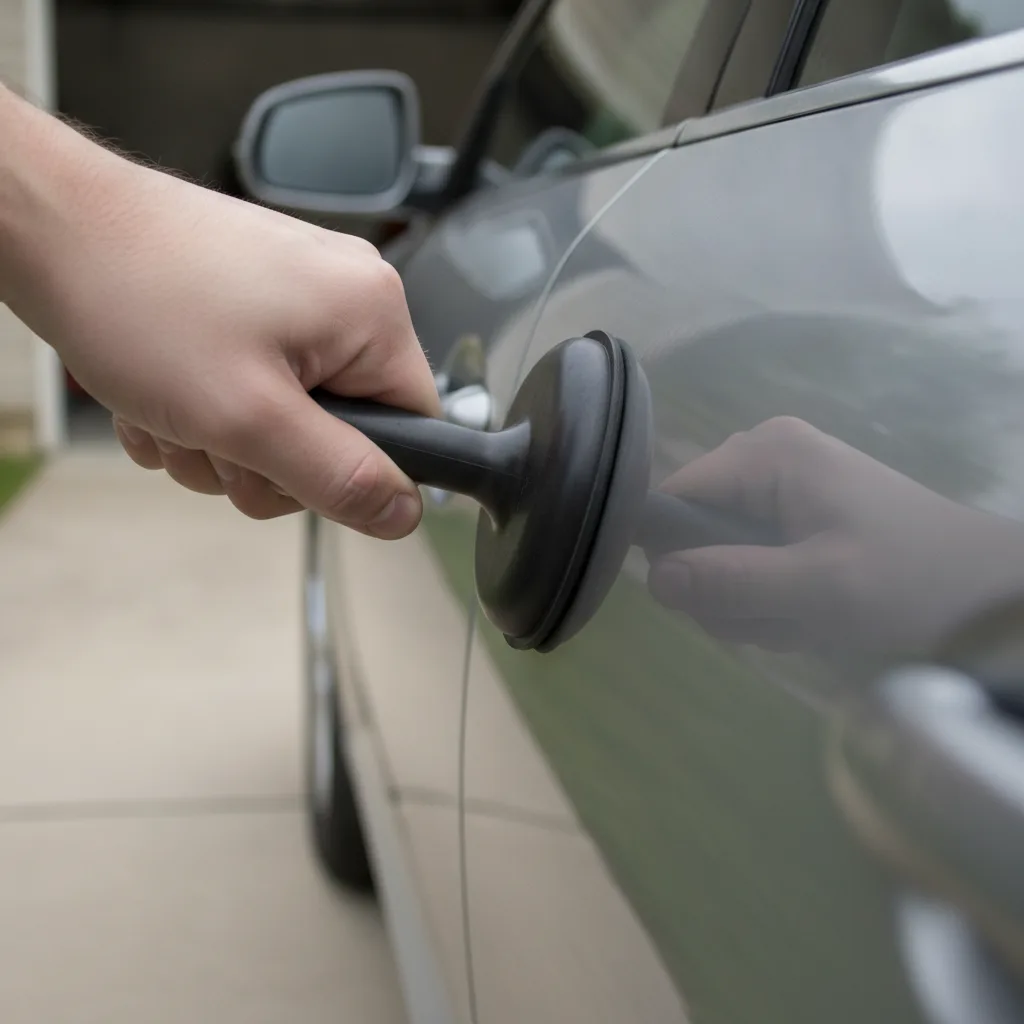
- Suction cups. A rubber cup you stick on and pull, from a five-dollar phone-mount style up to a bigger handled version. Pure suction, no glue.
- Glue-pull kits. A glue gun, plastic tabs, and a bridge or slide puller. You glue a tab to the dent and pull it out, then release the tab. This is the one pros actually use a version of.
- Drill-in or hot-glue slide-hammer kits. The bigger boxes, sometimes with tabs you screw or hook in. A few older kits even had you drill the panel. These are the ones that get people in trouble.
- Hot water and a plunger. Not a kit at all, an internet trick. Boiling water or a hair dryer plus a plunger or your hands. Mostly a plastic-bumper move.
The rest of this guide is about which of these earns its spot in your trunk and which one costs you a body-shop bill later. If you would rather skip the experiment, the honest cost read is in what dent removal actually costs.
Suction-cup pullers: cheap, and the ones that fail most
Suction cups rarely move real body metal. They can lift a big, shallow, flexible dent on a smooth panel, but they slip off anything sharp and do nothing to a firm ding.
Suction is the tool everyone tries first because it is five or ten dollars and it looks easy in the ad. In the shop videos, and in the one linked below, you see the same result over and over: on a genuine dented panel, the cup either will not hold, or it holds and pops right off without moving the metal. It can occasionally help on a large, very shallow, flexible dent, like a wide soft dent on a door skin, where the metal wants to spring back anyway. But a normal door ding is firmer than the suction can grab, and any crease or edge breaks the seal instantly. It will not scratch your paint, so it is a safe thing to try. Just do not expect much, and do not buy the 40-dollar version thinking a bigger cup changes the physics. The video below is an auto body shop running these tools on real dents, and it is the most honest two minutes you will spend before buying one.
Glue-pull kits: the one type that can actually work
Glue-pull kits are the DIY tool worth owning. On a shallow, round, paint-intact dent they can pull real metal, because they grip the surface without touching your paint.
If you are going to buy one thing, buy a glue-pull kit. It is the closest cousin to a real paintless dent repair tool. You heat glue onto a plastic tab, stick it to the low point of the dent, let it set, then use a little bridge or slide puller to lift the tab, and the metal comes with it. Because the pull happens through a glued tab and not a drill or a screw, it does not damage your paint when you do it right. On a clean, shallow, rounded ding I would put honest odds on a patient person getting it 60 to 80 percent better. Not always perfect, but a lot less noticeable. The catch is the two things the kit cannot give you: knowing exactly how hard to pull, and a way to tap the little high spots back down afterward. That is the difference between my work and a kit, and it is real. This is the same basic pull I do, just without the trained hand and the finishing taps. For the full picture of how the pro version works, read how paintless dent repair actually works.
How to use a glue-pull kit without making it worse
Confirm the dent qualifies, clean and warm the panel, glue a tab to the center, pull straight out gently, release the tab with the remover, then stop before you chase it.
If you have the right dent and a glue-pull kit, here is the honest process, and the one rule that matters most is knowing when to stop. First, make sure the dent is shallow, round, and the paint is not cracked, because a kit cannot fix a crease and will worsen chipped paint. Second, wash and dry the spot and warm the panel with a hair dryer on a cool day so the glue grips. Third, heat the glue, press a tab onto the lowest point of the dent, and hold it a full minute until it sets hard. Fourth, fit the puller over the tab and turn the knob slowly, coaxing the metal out, and stop before it feels tight. Fifth, use the release fluid in the kit to slide the tab off sideways, never twist or rip it, because ripping a tab can lift your paint. Sixth, look at the panel from a low angle in good light. If it is better, take the win and stop. If a high spot popped up, that is exactly the moment to stop chasing it and send a pro a photo, before a fixable dent turns into a paint job. The steps are laid out again in the how-to box on this page.
Drill-in and slide-hammer kits: how they leave you worse off
The heavy slide-hammer and drill-in kits are where DIY goes wrong. They can stretch the metal, pop high spots you cannot fix, and any kit that drills or screws the panel opens the door to rust.
These are the boxes that look the most serious, so people assume they work the best. They are the ones I re-fix the most. A slide hammer yanks hard and fast, and on a thin body panel that overshoots, stretching the metal and leaving a raised high spot or a wavy area that is now harder to fix than the original dent. Worse are any tabs or kits that hook, screw, or drill into the panel. The second you break the paint or the metal, you have created a spot where water gets in and rust starts, and here in the DMV, with the winter road salt, that rust will find it. I have seen a simple 200-dollar door ding turn into a body-and-paint bill because someone reached for the aggressive kit. If your dent is big or sharp enough that a glue tab will not touch it, that is your sign it needs a real tool and a trained hand, not more force. The honest comparison of doing it right versus a shop is in PDR versus a body shop, and the mobile side in mobile versus shop repair.
Hot water and plunger tricks: what they can and cannot do
The boiling-water and plunger tricks only work on flexible plastic bumpers, never on metal panels. They can push a soft bumper dent back, but they do nothing for a real body dent.
You have seen the videos: pour boiling water on a dent, push from behind, and it pops out like magic. Here is the truth. That trick works on a plastic bumper cover, because plastic gets soft and flexible with heat and has some memory that wants to return to shape. It does almost nothing on a steel or aluminum body panel, which does not soften in hot tap water and holds its dented shape. So if your dent is on a plastic bumper, warming it and pushing from behind is a legitimate thing to try, and I explain the safe way to do it in how to fix a dent in a plastic bumper. If your dent is on a door, fender, hood, or quarter panel, skip the kettle. It is metal, and no amount of hot water is bringing it back.
Why your kit left the dent close but not gone, and when to call a pro
Metal has memory and high spots that a kit cannot read or tap down. When a dent comes out close but not clean, or a high spot popped, that is the point to stop and get a photo to a pro.
This is the part the product listings never explain. When you push or pull a dent, the metal does not just go flat, it fights back, and the last 20 percent is all about tapping the tiny high spots down and easing the low spots up until light runs across the panel clean. A kit gives you the pull and nothing else. That is why so many DIY dents end up close but not gone, or with a little pimple of a high spot the puller raised. There is no shame in that. It is the exact line between a tool and a trade. What I do mobile is finish that last 20 percent, and often undo an over-pull, in your driveway in Alexandria, Arlington, Fairfax, Falls Church, or McLean, with no shop visit. My honest advice is simple: if you have a shallow round ding and want to try a glue-pull kit, go for it, and stop the second it looks close. If it is creased, sharp, on a body line, or the paint is cracked, do not buy the kit at all. Send me a couple of clear photos and I will tell you straight what it needs and what it costs before you spend a dollar. A quick honest read beats a kit that turns a small dent into a big one. If the ding started as a parking-lot door tap, the numbers are in door ding repair cost.
Frequently asked questions about DIY dent removal kits
Do dent pullers actually work?
Glue-pull dent pullers can work on a shallow, round dent with intact paint and no crease. Suction cups rarely move real body metal. No puller fixes a creased or sharp dent, and none can tap down the high spots a pro finishes by hand.
Which DIY dent removal kit is best?
A glue-pull kit with a bridge or slide puller and plastic tabs is the one worth buying, because it grips through a glued tab and does not touch your paint. Avoid the drill-in or aggressive slide-hammer kits, which can stretch metal and damage paint.
Can a DIY dent kit ruin my car?
Yes, the wrong kit can. Slide hammers can stretch the panel and pop high spots, and any tab that screws or drills in breaks the paint and starts rust. A glue-pull kit used gently on the right dent is the low-risk option.
Does the boiling water and plunger trick work on dents?
Only on plastic bumpers. Heat softens plastic so it can flex back toward shape. On steel or aluminum body panels the trick does nothing, because the metal does not soften in hot water and holds its dented shape.
Why did my dent puller leave a high spot?
You pulled too far. Metal overshoots when you pull hard, raising a small high spot the kit cannot push back down. Pull gently, stop before it feels tight, and if a high spot appears, stop and get a pro to tap it flat.
Is it cheaper to fix a dent yourself or hire a pro?
A kit costs less up front, but only helps on a shallow round ding. If a kit leaves a high spot or damages paint, the repair costs more than the original dent. On the right small dent a kit can save money. On anything creased, a pro is cheaper in the end.
Can you fix a car door dent with a kit?
A shallow, round door dent with intact paint, sometimes, with a glue-pull kit. A sharp door crease or a dent on the body line, no. Door skins are thin and easy to over-pull, so pull gently and stop early, or send a photo first.
The bottom line
DIY dent kits are not a scam, but they are not magic either. A glue-pull kit is a real tool that can improve a shallow, round, paint-intact ding if you are patient and you stop early. Suction cups mostly do nothing, the drill-in and slide-hammer kits are how a small dent becomes a paint job, and the hot-water trick is a plastic-bumper move only. What no kit gives you is the trained hand that reads the metal and taps the high spots flat, which is the whole last stretch of the job. So try the glue-pull kit on the right dent, keep your money in your pocket on the rest, and when it looks close but not gone, that is your cue. Send me a photo and I will tell you the truth before you spend anything.
Buster has been doing mobile paintless dent repair across the DMV for 20+ years. He pulls dents from the inside of the panel, no body shop, no repaint, factory finish stays. Most jobs done at your driveway in 1 to 2 hours.