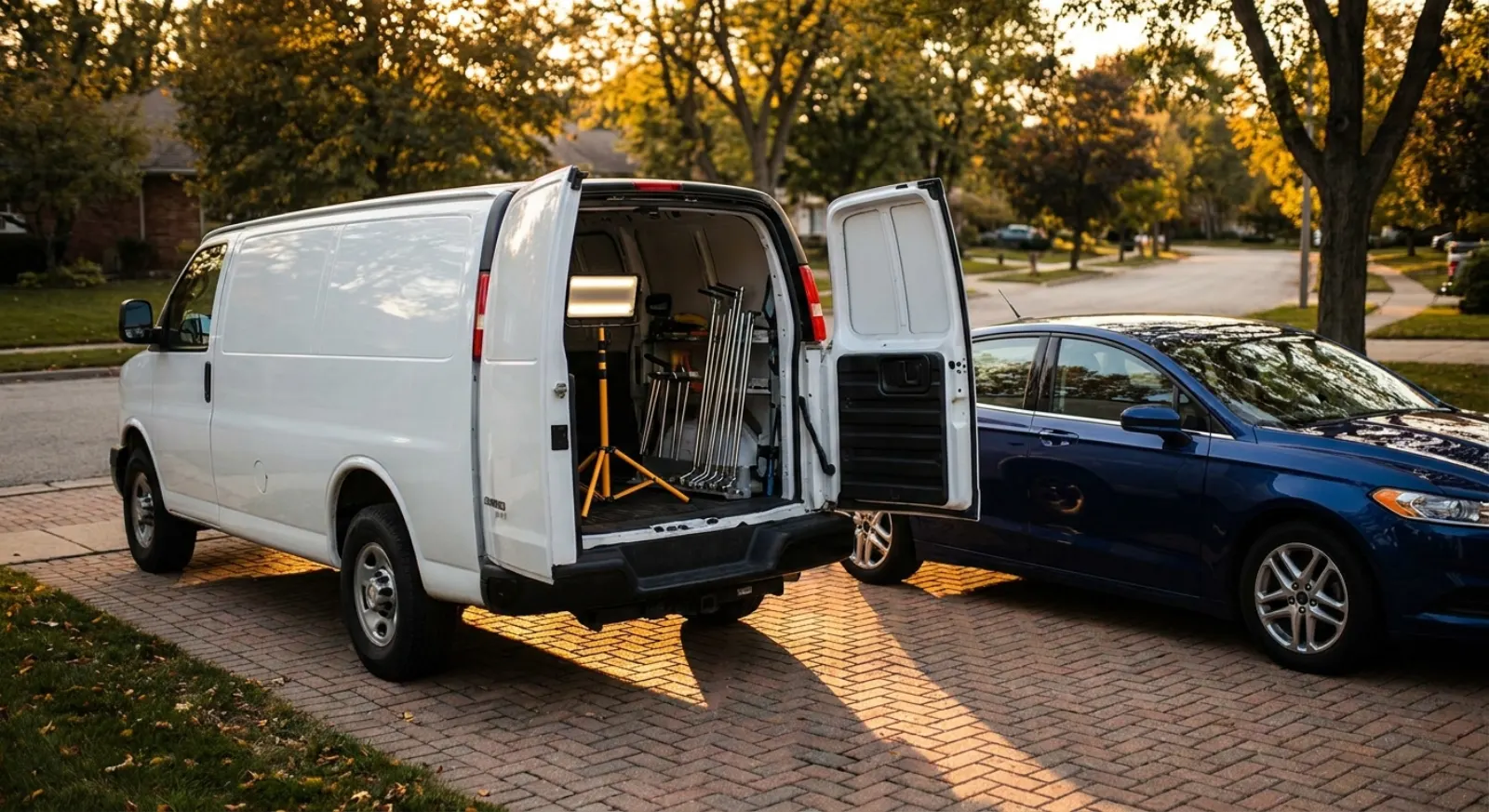

Short version: Dent removal in the DMV in 2026 runs anywhere from $0 (clean DIY plunger pop on a shallow round dent) to $4,500 (body shop replace and respray on a deep crease with torn paint and edge damage). The honest middle is $100 to $1,200 for almost every real-world dent if you use paintless dent repair (PDR) at your driveway, $700 to $2,500 if you take the same dent to a body shop, and $30 to $200 plus a 50/50 outcome if you DIY. PDR wins on roughly 8 out of 10 dents I see across Alexandria, Arlington, Fairfax, Falls Church, and McLean. Body shop is the right call when the paint is torn through to bare metal, the panel has a sharp crease through a body line, the metal has stretched past its elastic limit, or a structural part bent. DIY is honest money only on shallow round dents where the paint is intact and the panel back is accessible. After 20+ years pulling dents in DMV driveways, here is the real math by method and damage type, the three-question test I run before quoting, and the four mistakes that turn a $200 dent into a $1,800 dent.
How much does dent removal cost in 2026 in the DMV
The price of dent removal moves on three things: the method (PDR, body shop, or DIY), the damage type (size, depth, location on the panel, paint condition), and the vehicle (steel vs aluminum, common color vs custom paint code). The table below is what I actually charge mobile in DMV driveways, what the body shops up the road quote on the same damage, and what the honest DIY range looks like when the conditions are right.
| Dent type | Mobile PDR (DMV) | Body shop quote | DIY range |
|---|---|---|---|
| Shopping cart ding, small round, paint intact | $75 to $150 | $400 to $700 (respray) | $0 to $30 (plunger or hot water) |
| Door ding, 1 to 2 inches, shallow | $100 to $200 | $500 to $850 | $30 to $80 (suction kit) |
| Medium round dent, 3 to 5 inches | $200 to $450 | $700 to $1,200 | Not honest DIY territory |
| Large round dent, 5 to 8 inches | $350 to $700 | $1,000 to $1,600 | Not honest DIY territory |
| Long crease, branch fall or slide | $500 to $1,000 | $1,300 to $2,200 | Do not attempt |
| Body line crease through a sharp edge | $400 to $900 (PDR + light touch-up) | $1,200 to $2,000 | Do not attempt |
| Edge dent on the lip of a panel | $300 to $700 | $900 to $1,500 | Do not attempt |
| Hail pattern, 20 to 40 dents | $400 to $900 | $1,500 to $3,000 | Do not attempt |
| Paint torn through to bare metal | Body shop territory | $800 to $1,800 (paint, blend, clear) | $25 touch-up pen, weak result |
| Panel replace and respray | Not a PDR job | $1,800 to $4,500 | Do not attempt |
These ranges hold for steel panels with intact paint, where the metal is still within its elastic limit and the back of the panel is accessible. Aluminum hoods, doors, and beds (Ford F-150 from 2015 on, Tesla Model S, Model X, Model Y rear quarter, late Lexus, Audi A6 and A8, BMW M cars, Porsche, Jaguar, Range Rover) add 25 to 50 percent to the PDR range because aluminum stretches differently and requires specialty heat tools. For per-size pricing on PDR specifically see how much does paintless dent repair cost, for door-zone-specific pricing see car door dent repair cost, and for hood damage specifically see hood dent repair cost.
The three dent removal methods and what each one actually is
There are exactly three ways to remove a dent from a car panel in 2026. They are not interchangeable, and confusing them is how customers end up paying twice. Here is what each one does mechanically and what it costs.
Paintless dent repair (PDR) is pushing the metal back to its original shape from behind the panel using specialty rods, with no paint, no filler, no body putty, and no respray. It preserves the factory paint film, factory clear coat, and factory thickness. It works on roughly 80 percent of the dents I see in DMV driveways because most dents are shallow enough that the paint is still intact. DMV mobile PDR runs $75 for a small ding up to $1,000 for a long crease.
Body shop repair is the traditional path: pull or fill the dent, sand it back, primer, paint to match, clear coat, and bake. It is the right call when the paint is torn, when the metal has stretched past its elastic limit and will not return, when a sharp body-line crease cracks the clear coat, or when the panel has to come off and be replaced. Body shop work starts at $700 for the smallest jobs and runs past $2,500 once a full hood, door, or fender gets replaced and resprayed.
DIY dent removal is the plunger, hot water and compressed air, suction-cup puller, glue-pulling kit, or the heat-and-cold method. DIY honestly works on one class of damage: shallow round dents on flat metal sections (not corners, not edges, not body lines), where the paint is fully intact and the dent popped in cleanly without stretching the surrounding metal. On that class, a $30 suction kit fixes the dent in 15 minutes. Outside that class, DIY makes the panel worse 50 percent of the time and locks you into a body shop repaint instead of the cheaper PDR fix you had before you tried.
Paintless dent repair (PDR) cost in 2026: when it wins
PDR wins when three conditions are all true: the paint is intact (do the fingernail test, drag a nail across the dent edge, if it does not catch, the paint is intact), the metal has not stretched past its elastic limit (no sharp crease through a body line, no oil-canning, no bulge on the back side), and the back of the panel is accessible through trim removal or window-channel access. When all three are true, PDR is the cheapest, fastest, and most paint-preserving option, and it is what I do at customer driveways across the DMV all day.
Real DMV mobile PDR pricing by size and severity: a single small ding from a parking lot or shopping cart runs $75 to $150 and finishes in 30 to 45 minutes. A 3 to 5 inch round dent on a door or fender runs $200 to $450 and finishes in 60 to 90 minutes. A long branch-fall crease on a hood runs $500 to $1,000 and takes 3 to 5 hours. A hail-damaged panel with 20 to 40 dents runs $400 to $900 per panel depending on dent density. Aluminum panels add 25 to 50 percent because the metal pushes back harder and the heat tools take longer to set up. PDR pricing is what I post against the body shop quote on the same damage in the PDR vs body shop comparison.
Body shop cost in 2026: when the dent crossed the PDR line
A body shop is the right call in five specific cases, and they are the cases where PDR would either fail or leave a visible defect. Case one: the paint is torn through to bare metal (rust will start within 48 hours if you wait). Case two: the dent has a sharp crease through a body line and the clear coat has cracked along the line. Case three: the metal has stretched past its elastic limit and oil-cans (pops in and out when you press it). Case four: the panel is bent through reinforcement structure underneath (hat channels, door beam, frame rail), which PDR cannot reach. Case five: the customer wants the panel replaced rather than repaired (typical for cars in their lease return window or pre-sale photo prep where any history of repair work has to be invisible).
Real DMV body shop pricing in 2026: the smallest paint-and-blend job (a single door panel with a torn-paint dent the size of a quarter) starts around $700 to $900 because the shop has to mask, sand, primer, paint, and clear coat the whole panel for color match. A full door respray with a deep crease runs $1,200 to $1,800. A hood replace and respray on a current-year vehicle runs $1,800 to $3,500 depending on the make and color. Insurance-grade paint matches on luxury paint codes (Tesla PPSW Pearl White Multi-Coat, Audi Nardo Grey, Porsche Crayon, BMW Frozen Black) add $200 to $600 because the color requires more layers and tri-coat blending. If the body shop quote on a dent is $1,500 and the paint is still intact, I can almost always do the same dent for $300 to $500 with PDR and the factory paint film stays untouched.
DIY dent removal cost in 2026: when it works and when it costs more
DIY works on exactly one class of damage: shallow round dents on flat panel sections with fully intact paint and accessible panel backs. On a clean parking lot ding on the middle of a door or quarter panel, a $30 suction-cup kit from a parts store pulls the dent flush in 15 minutes 50 percent of the time. The plunger method (cup plunger, soapy water, firm pull) works on the same class for the price of a plunger. The hot water plus compressed air trick (pour boiling water over the dent, then spray inverted compressed air to flash-freeze) works on shallow round dents on plastic bumpers about 40 percent of the time. Those are the honest DIY wins.
The DIY costs that surprise customers come from the other 50 percent. Glue-pulling kits ($25 to $80) are easy to misuse and leave glue residue burned into the clear coat that a body shop has to wet-sand off ($150 to $300 fix). Dent-puller suction kits used on a body-line crease pop the panel out unevenly and stretch the metal, turning a $300 PDR job into a $1,200 body shop respray. Touch-up paint pens ($15 to $25) over a dent that was never properly pulled leave a visible blob in direct sunlight that requires sanding and full-panel respray to remove. The math is brutal: a successful DIY saves $100 to $200, a failed DIY costs $500 to $1,500 extra. Before you try DIY, read how to get a dent out of a car for the cases where DIY is honestly worth the risk.
How to pick the right method: the three-question test I run
Before I quote any dent in a customer driveway, I run the same three questions in the same order. They take 90 seconds and they decide PDR, body shop, or DIY without guessing.
Question one: is the paint intact? Drag a fingernail across the deepest part of the dent. If the nail does not catch on any edge, ridge, or torn paint, the paint is intact and PDR is in play. If the nail catches on torn paint or you can see bare metal at the bottom of the dent, the paint is broken and you are in body shop territory. There is no PDR path for torn paint because PDR cannot replace missing paint.
Question two: did the metal cross a body line or sharp edge? Look at the dent against the panel's character lines (the sharp creases that run the length of the door, fender, or quarter panel). If the dent is entirely inside a flat section, PDR pricing holds. If the dent runs through a body line or sits on the lip edge of a panel, PDR is still possible but the price jumps 50 to 100 percent because the body line has to be brought back perfectly straight or the repair shows.
Question three: can I see the back of the panel? PDR needs access to push the metal from behind. Doors, fenders, and quarter panels are accessible through trim removal or window-channel work. Hoods are accessible by opening the hood. Roofs are accessible by dropping the headliner ($150 to $300 of extra labor on most cars). Pillars, frame rails, and structural reinforcements are not accessible to PDR and the damage has to go to a body shop. If a panel cannot be accessed without cutting metal, PDR is off the table.
Vehicle-specific cost factors: aluminum, luxury paint, electric vehicles
Three vehicle types change the PDR pricing math even when the damage is identical. Aluminum-bodied vehicles (Ford F-150 from 2015 on, Tesla Model S and Model X bodies, Tesla Model Y rear quarters, late Lexus, Audi A6 and A8, BMW M cars, Porsche, Jaguar, Range Rover) need specialty heat tools and a slower technique because aluminum stretches differently than steel and does not return as predictably. Aluminum PDR adds 25 to 50 percent to the steel pricing. The full breakdown is in why aluminum body panels need a specialist for PDR.
Luxury paint codes (Tesla PPSW Pearl White Multi-Coat, Audi Nardo Grey, Porsche Crayon, BMW Frozen series, Mercedes Designo) change the body shop math, not the PDR math, because PDR preserves the factory paint regardless of code. A $700 PDR job is $700 whether the paint is Standard White or PPSW. The same dent at the body shop is $1,200 in Standard White and $2,400 in PPSW because the tri-coat respray and color match takes more material and more bake cycles. This is why luxury vehicle owners with intact paint almost always choose PDR.
Electric vehicles (Tesla, Rivian, Lucid, Polestar, Ford Mach-E, ID.4) have nothing structurally different on the PDR side, but two practical factors matter. The aluminum hood and quarter surcharge applies (Tesla S, X, and Y rear quarter are aluminum). And electric vehicles have higher cash value at lease return, which makes preserving the factory paint film financially worth more on resale than on an equivalent gas vehicle. The Tesla-specific deep dive is in Tesla dent repair cost by model and panel.
What insurance covers and what comes out of pocket
Insurance covers dent removal in two cases and not in the others. Comprehensive coverage (sometimes called "other than collision") covers hail damage, falling tree branches, vandalism dents, and animal-caused damage. The deductible is what you pay out of pocket, the rest is the insurance company's bill. On a $1,200 hail repair with a $500 deductible, you pay $500 and the carrier pays $700. Collision coverage covers dents from accidents where another vehicle or fixed object caused the damage, with the same deductible math.
Insurance does not cover everyday dents: parking lot door dings, shopping cart hits where no other vehicle is identified, dings from your own garage, dents from your own kids, or any damage you cannot tie to a specific covered incident. Those are out of pocket, which is exactly the price range where PDR's $75 to $700 menu makes the most sense. The full insurance decision-math is in will insurance cover dent repair, and the hail-specific file-vs-cash math is in hail damage insurance claim or cash pay.
Real DMV dent removal jobs I quoted this month
The pricing above is built from work I do every week. Three jobs from the past two weeks in the DMV that show the method-pick in action:
Tysons Galleria, 2024 Audi Q5, Nardo Grey. Customer texted a photo of a 2-inch door ding from a shopping cart at the Whole Foods lot. Paint intact, fingernail test clean, flat section of the rear door. PDR at her driveway, 45 minutes, $145. Audi dealer service had quoted $1,150 for a full door respray. The Nardo Grey paint code is exactly why PDR was the right answer: a body shop respray on Nardo runs $400 above standard paint because of the color match.
Old Town Alexandria, 2019 Tesla Model 3, Pearl White. Branch fell on the hood during a March storm, leaving a 7-inch shallow crease and one paint chip the size of a dime. Paint mostly intact on the crease itself, torn at the chip. Did PDR on the crease ($650, 3 hours), referred the customer to a paint specialist for the chip-only touch-up ($120 separate visit). Total: $770. Tesla service center had quoted $2,400 for a hood replace because they do not separate the two damage types.
Falls Church Costco lot, 2022 Honda Pilot, Modern Steel Metallic. Customer attempted DIY with a glue-pulling kit on a 4-inch round dent on the rear quarter panel. The kit pulled the dent unevenly and stretched the metal in two spots. Original PDR job would have been $350. Final price after the failed DIY: $550 because I had to spend an extra hour bringing the stretched metal back. He saved nothing by trying it himself, and got lucky the paint did not tear.
FAQs about dent removal cost
What is the cheapest way to remove a dent from a car?
The cheapest method that produces a clean result is paintless dent repair (PDR) at $75 to $200 for the smallest dings. DIY is cheaper only when it works, which is about 50 percent of the time on shallow round dents with intact paint. Failed DIY typically adds $300 to $1,200 to the eventual fix. Body shop work is the most expensive option on small dents because the shop has to respray the whole panel for color match.
Is dent removal worth the cost?
On most vehicles in the DMV resale market, yes. A $200 PDR job on a daily driver protects $500 to $1,200 of resale value at trade-in or private sale because the factory paint stays intact. On a leased vehicle, a $300 PDR fix avoids a $700 to $1,500 lease-return charge from the dealer. The repair pays for itself most cleanly when you keep the car at least a year after the fix. For lease-return specifics see which dents to fix before turning your lease in.
Will my insurance rates go up if I file a claim for dent removal?
It depends on which coverage. Comprehensive claims (hail, falling branch, vandalism, animal) typically do not raise rates because they are not driver-fault incidents. Collision claims usually do raise rates 5 to 15 percent for three years. On dents under your deductible plus $400, cash-pay almost always beats filing. On hail damage above $1,500, comprehensive filing usually wins. The full decision-math is in hail damage insurance claim or cash pay.
How long does dent removal take?
PDR on a single dent at your driveway is 30 to 90 minutes. PDR on a multi-dent job (3 to 5 dents across one panel) is 2 to 4 hours. PDR on hail damage with 20 to 40 dents per panel is a full day, sometimes two. Body shop work is 3 to 7 days because of paint, primer, and clear coat cure cycles plus respray prep. DIY is 15 to 45 minutes if it works the first try. Full timeline detail is in how long does paintless dent repair take.
Can a dent come back after PDR?
Not on a properly executed PDR repair. The metal is pushed back to its original shape and held there by the panel's surrounding structure. The only cases where a PDR repair "comes back" are when the original tech did not push the metal fully (low spot left in the panel) or when the same panel takes a new dent in the same spot. On a clean repair the factory paint film and the metal underneath stay where I put them.
Does paintless dent repair really not need paint?
Correct. PDR pushes the existing metal back to shape without adding filler, primer, or paint. The factory paint film, clear coat, and the original factory thickness all stay intact. If the paint was already torn before the dent was repaired, PDR fixes the dent but does not replace the missing paint, and a small touch-up is needed separately. The full process walkthrough is in PDR vs body shop: what's the real difference.
What size dent is too big for PDR?
The size limit is less about diameter and more about depth and paint condition. I have pulled 10-inch crease dents successfully when the metal was shallow and the paint was intact. I have referred 2-inch dents to a body shop when the paint was torn or the metal stretched. A reasonable working rule: if the dent is shallow enough that the fingernail test does not catch and the metal underneath has not stretched into a permanent ridge, PDR is in play regardless of how big across it looks.
Is mobile dent removal as good as a shop?
For PDR work, yes. The tools I use in a driveway are the same tools used in a shop bay. The lighting comes from portable PDR boards calibrated to the same standard as shop lighting. The technique is identical. The only thing a shop adds for PDR specifically is bay space, which matters on multi-day hail jobs but not on single-dent repairs. For paint work, a shop has spray booths and cure ovens that mobile cannot replicate, so any dent that needs paint goes to a shop. The mobile-vs-shop comparison for PDR specifically is in mobile vs shop paintless dent repair.
Get a real dent removal quote in 30 minutes
If you have a dent and want an honest method-pick before you commit to a price, send three photos: one straight-on from 3 feet, one at an angle from the side showing the reflection along the panel, and one close-up of the paint condition at the deepest point of the dent. With those three photos I can tell you within 30 minutes whether you are looking at $75, $400, $1,200, or body shop territory, and which method is the right one for the specific damage. Mobile PDR comes to you across Alexandria, Arlington, Fairfax, Falls Church, and McLean.
Buster has been doing mobile paintless dent repair across the DMV for 20+ years. He pulls dents from the inside of the panel. No body shop, no repaint, factory finish stays. Most jobs done at your driveway in 1 to 2 hours.