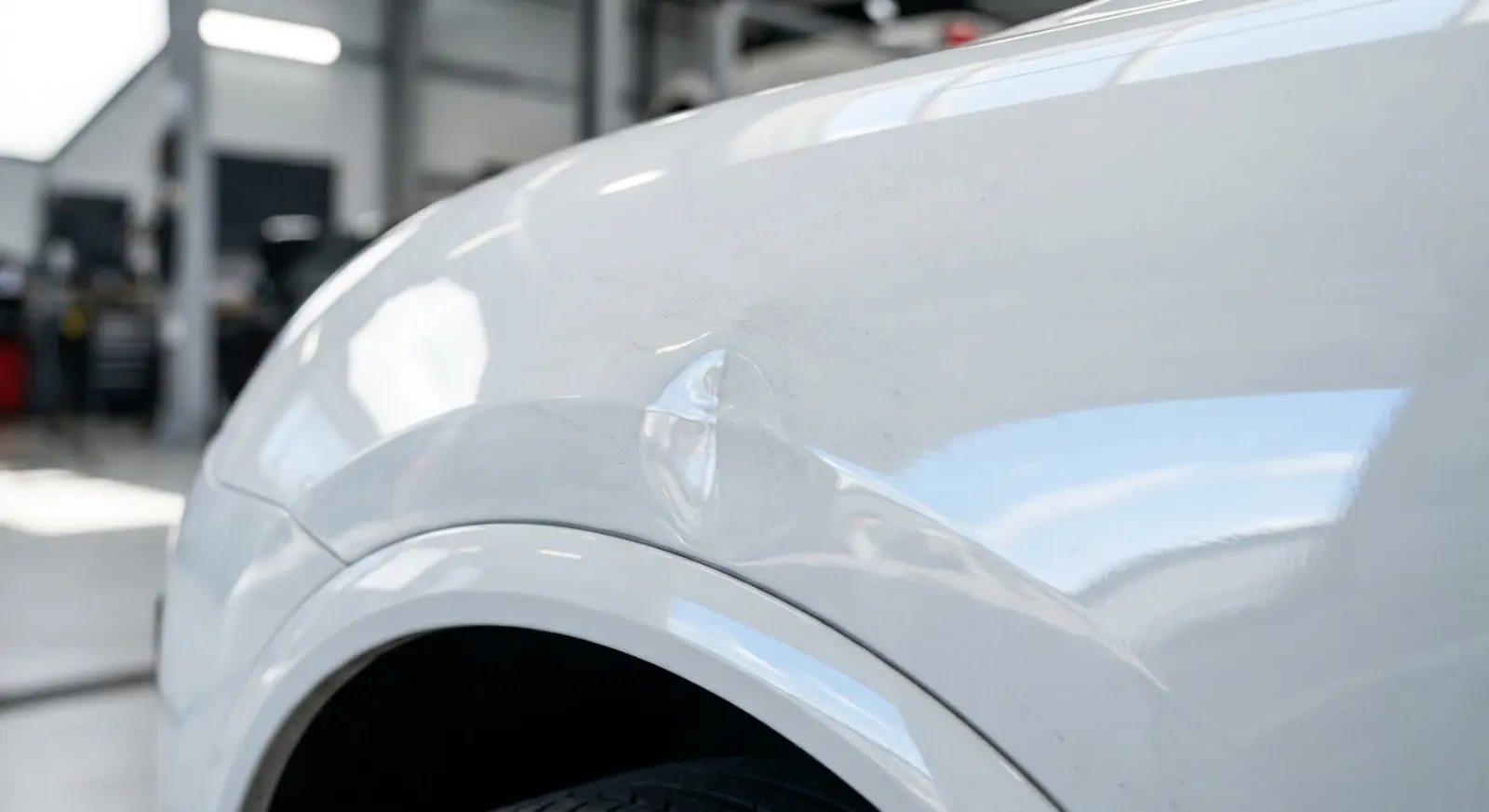
Short version: A typical fender bender in the DMV runs $200 to $1,500 at a mobile rate, depending on what got hit and how hard. A pure bumper scuff with paint intact is $125 to $250. A scuffed and slightly cracked plastic bumper is $250 to $500. A creased fender with paint torn is $400 to $900. A combination fender plus bumper plus headlight surround is $700 to $1,500. Body shop quotes on the same damage start at $900 and push past $3,500 because they default to panel removal, primer, and full repaint. After 20+ years pulling fender benders apart in Alexandria, Arlington, Fairfax, and Loudoun driveways, here is the real math by damage type, why mobile beats body shop on most jobs, when filing insurance pays and when cash wins, and the three photos I need to give you a real quote in under an hour.
How much does fender bender repair cost in the DMV in 2026
Mobile fender bender repair at my DMV rate runs $200 to $1,500 for the vast majority of jobs. The price moves on four things: which panels are hit (bumper alone, fender alone, or both), whether the paint is intact or torn, whether the metal underneath is steel or aluminum, and whether any hardware (headlight, marker light, wheel liner, sensor) is damaged behind the panel. A body shop estimate on the same damage starts at $900 just for the labor and paint, and pushes past $2,500 if they decide to replace the bumper cover or the fender. The table below is what I actually charge in your driveway in Old Town, Del Ray, Clarendon, Pentagon City, Tysons, or Fair Oaks, against what the shops up the road quote for the same job.
| Damage type | Mobile repair (DMV) | Body shop quote | Time |
|---|---|---|---|
| Bumper corner scuff, paint intact | $125 to $200 | $500 to $900 (respray) | 60 to 90 min |
| Bumper scuff with paint scraped | $200 to $350 | $700 to $1,200 | 90 to 150 min |
| Plastic bumper cracked, paint scuffed | $300 to $550 | $900 to $1,800 (replace) | 2 to 3 hours |
| Fender dent, paint intact | $200 to $450 | $700 to $1,200 (respray) | 90 min to 2 hours |
| Fender crease, paint torn | $400 to $900 (PDR + touch-up) | $1,100 to $1,800 | 3 to 5 hours |
| Fender plus bumper, paint torn both | $700 to $1,300 | $1,800 to $3,200 | 1 day on-site or split |
| Fender plus bumper plus headlight surround | $900 to $1,500 | $2,500 to $4,500 | 1 to 2 days |
| Aluminum panel hit (Tesla, F-150, late Lexus) | Add 25 to 50 percent to ranges above | Add 30 to 60 percent | Add 30 to 90 min |
| Hardware damaged (sensor, headlight, latch bent) | Not a mobile job alone | $1,500 to $4,500 | Body shop or dealer |
These ranges are for single-vehicle fender benders in the DMV with no airbag deployment, no frame damage, and no fluid leaks. If your car is leaking, the hood will not latch, the steering pulls hard, or the airbag light is on, that is a tow-and-collision-shop job, not a fender bender. For per-size pricing on the dent side of the math see how much does paintless dent repair cost, and for the bumper-specific math see plastic bumper repair cost.
What counts as a fender bender vs a real collision
A fender bender is low-speed cosmetic damage. The classic trade definition: under 10 mph impact, paint and panel damage only, no airbag deployment, no frame distortion, no fluid leaks, all hardware behind the panel still works. The car still drives, still steers straight, still stops, and the doors still open and close square. Parking lot tap from behind, backing into a pole, a glancing scrape against a guardrail at low speed, a shopping cart loaded with a case of water rolling into your fender, somebody opening their door into your front quarter. Those are fender benders.
What is not a fender bender, even if it looks small: anything where the bumper got pushed in far enough to touch the radiator, anything where the hood does not latch, anything that left the steering wheel off-center after the hit, anything with a tire that no longer points the same direction as its mate, anything with a triangle warning lit on the dash that did not light before. Those need a collision shop with a frame rack and a scanner, not a mobile fender bender fix. I tell DMV customers this in the driveway so we do not waste an hour pricing a repair on a car that needs a tow first.
The damage signatures that almost always stay in fender bender territory: scuffed bumper corners, creased fenders that are still bolted square to the body, plastic trim torn loose, paint scraped down to primer or bare metal on a small area, mirror caps cracked, headlight surrounds nicked. Those are the bread-and-butter mobile auto body and paint jobs.
The 4 most common fender bender damage patterns I see in the DMV
After two decades doing mobile work across the DMV, four patterns make up roughly 80 percent of fender bender calls. Knowing which pattern you have inside of 30 seconds puts you within $100 of an honest quote before anyone shows up.
- Parking lot bumper corner scuff. Somebody clipped the corner of your front or rear bumper in a Target, Costco, or Trader Joe lot. Paint is scraped, plastic is gouged but not cracked, no panel deformation. Real DMV mobile price: $125 to $300, 60 to 90 minutes on-site. Body shop will quote $600 to $1,000 for "respray the bumper cover" and want the car for 3 days.
- Reverse-into-pole rear quarter or bumper crease. Backing out of a tight Old Town garage, the Pentagon City basement, or a townhouse driveway and catching a pole on the rear quarter or bumper edge. Paint is usually intact at the deepest point but torn along the leading edge. Real DMV mobile price: $350 to $750 paintless plus touch-up. Body shop: $1,000 to $1,700.
- Front fender hit from another car door or low-speed tap. Front quarter panel pushed in, sometimes with paint scraped where the other car contacted yours, headlight surround nicked. Real DMV mobile price: $400 to $900 if the panel can be paintless-pulled and touch-up applied, or refer to body shop if the headlight bracket bent. Body shop: $1,200 to $2,200.
- Combination front bumper plus fender plus marker light. Low-speed front-corner collision (rear-ending a stopped car at a stoplight, sliding on Beltway slush into the car ahead). Bumper cracked, fender creased, marker light or headlight surround damaged, paint torn across both panels. Real DMV mobile price: $700 to $1,500. Body shop: $1,800 to $3,500 with rental car for 4 to 7 days.
For the bumper crack specifically and how plastic repair pricing works, see plastic bumper repair cost. For the paint touch-up math on torn paint see paint chip repair cost.
Mobile fender bender repair vs body shop: the real cost split
The dollar gap between mobile and body shop on the same damage is usually 2x to 3x, and the reason is structural, not greed. A body shop quotes the way they have been quoting for 30 years: bumper cover replacement, fender removal, primer, paint mixing, spray booth time, blend coat into adjacent panels, clear coat, polish. Every step assumes the worst-case fix, even when the damage does not need it. The default body shop process turns a $300 paintless-plus-touch-up job into a $1,200 panel respray because the math is built for total collision work, not low-speed cosmetic damage.
Mobile fender bender repair pulls dents from the inside of the panel where the metal is still good, blends paint where the topcoat is torn, and uses a factory-code color match for the affected area only. Total dwell time is 1 to 4 hours in your driveway versus 3 to 7 days at the shop. No rental car, no shop schedule, no priming a half-perfect panel. The mobile rate covers labor and materials directly, with no shop overhead loaded on top.
Where the body shop wins: any job where panel removal is actually required (replacement bumper cover, replacement fender, hardware swap behind the panel), any job involving frame or structural work, any job with airbag system involvement, and any insurance claim where the carrier requires direct billing through a shop in their network. The full mechanics of the mobile vs shop tradeoff live in mobile vs shop paintless dent repair and PDR vs body shop.
Insurance claim or cash pay on a fender bender: the decision math
The cash-pay math on a single fender bender almost always beats filing a claim. Here is why. A typical DMV personal auto policy has a $500 to $1,000 collision deductible. If the mobile fender bender repair is $400 to $1,000 cash, you are paying the same as or less than your deductible. The carrier covers nothing meaningful and the claim itself flags your premium for the next 3 to 5 years. Industry data on premium impact after a single at-fault claim shows surcharges of 30 to 50 percent in Virginia and Maryland, often more than the repair itself across the policy renewal cycle.
Filing wins on three scenarios. First, the damage is over $2,500 (full collision territory, hardware involved, possible frame work). Second, the other driver is clearly at fault and their carrier is covering it without your premium being touched. Third, the car is leased and the lease return is within 12 months, where filing through the other party's carrier produces a documented insurance repair that the leasing company accepts at handoff. The full file-or-cash decision tree for collision damage parallels the hail version at hail damage insurance claim or cash pay, and the carrier-by-carrier handling guide is at insurance and dent repair.
One tactical point. Carriers in the DMV (State Farm, Geico, Allstate, USAA, Progressive) all accept PDR plus touch-up as a covered repair when properly documented. If your damage is over $2,500 and you file, you can still steer toward a mobile-plus-paint solution by asking the carrier for an open-shop payment instead of network-direct-billing. That preserves the cash-equivalent value of a lower mobile bill.
Aluminum panels make fender bender repair 25 to 50 percent more expensive
Aluminum panels are common now: Tesla Model 3 and Model Y rear quarters, Ford F-150 hoods and beds (2015 and up), Jaguar full body, late-model Lexus hoods, Audi A8 panels, Porsche fenders on certain trims. Aluminum work-hardens faster than steel during the metal-pulling process, which means more push cycles and more time to bring the panel back to factory shape without stress-cracking the paint. The labor adjustment is 25 to 50 percent above the steel ranges in the table above, depending on how deep the dent is and where on the panel it sits.
What this means on a real DMV fender bender: a Model Y rear quarter crease that would be $400 to $700 on a steel quarter is $550 to $1,050 on the aluminum panel. An F-150 fender crease that would be $400 to $900 on steel is $550 to $1,300 on aluminum. A Lexus hood corner dent that would be $300 to $600 on a steel hood is $400 to $850 on the aluminum hood. The structural reason and the specific brand patterns live in aluminum body panel PDR. For Tesla-specific per-panel work see Tesla dent repair.
The 3 photos and 1 detail I need to quote your fender bender
Most DMV customers text me photos before they call. Three photos and one detail get me to a real number inside of 20 minutes. Photo one: a straight-on shot from about 6 feet back, showing the whole damaged area in frame with the rest of the panel visible for context. That tells me what panels are involved and how much real estate the damage covers. Photo two: an angled close-up from 18 inches, with a flashlight or phone light raking across the damage from the side, so the shadows show me depth and direction. That tells me whether it is a clean dent that can be pulled or a crease that needs more work. Photo three: a fingernail close-up at the deepest visible scratch or paint break. Run your nail across the damage. If your nail catches a crack or an edge, the paint is broken and the math shifts to include touch-up. If your nail glides clean, the paint is intact and most of the cost is the metal pull.
The one detail: year, make, model, trim, and factory paint code if you can find it (door jamb sticker, usually driver side). That tells me steel or aluminum, what trim hardware sits behind the panel, and whether the color is a pricing-protected paint (Tesla Pearl White Multi-Coat PPSW, BMW Frozen, Audi Nardo Grey, Porsche custom) where matching is a job by itself.
Why the dealer body shop quote is usually 2x the mobile rate
Dealer body shops in the DMV (Pohanka, Don Beyer, Sheehy, BMW of Fairfax, Mercedes-Benz of Arlington) quote off the OEM repair procedure manual, which assumes full panel removal, factory replacement parts, and book-rate labor at $140 to $190 per hour. A $400 mobile fender bender repair on a Honda Accord becomes a $1,400 dealer quote because the dealer process is: remove bumper cover (1.5 hours book rate), remove headlight assembly to access fender (1 hour), pull fender for blending access (2 hours), prime, paint, clear, polish (3 to 5 hours), reinstall (2 hours). Multiply 10 hours by $150 plus paint materials and you arrive at the quote.
That process is the right answer for a real collision, where the OEM warranty and factory-paint integrity matter and the parts are actually being replaced. It is the wrong answer for a parking lot fender bender where the metal underneath is fine, the paint just got torn in a small area, and the mobile fix preserves the original factory finish. The factory finish point matters for resale, lease return, and any future warranty inspection because a body shop respray is documented on the panel-thickness gauge readings that buyers, lease return inspectors, and CarFax-adjacent services check.
The lease-return premium on documented unrepaired versus mobile-repaired-but-factory-paint-intact panels in the DMV runs $300 to $1,200 per panel at turn-in. See lease return dent repair prep for the lease-specific math.
3 things I check in your driveway before I quote a fender bender
When I show up in Alexandria, Arlington, Fairfax, Falls Church, McLean, or anywhere in the DMV service radius, the in-person quote takes 5 minutes and runs the same three checks every time.
- Hardware behind the panel. I push lightly on the damaged area and look at how the panel sits relative to its neighbors. If the gap between the fender and the hood is still even, the bracket behind the fender is still square and the fix is paintless-plus-touch-up. If the gap widens at one end, the bracket is bent and the job is body-shop work. Same check on the bumper cover relative to the headlight surround and the fender edge.
- Paint break severity. Fingernail test in person, then a paint-thickness gauge if I have any doubt. A clean glide says factory paint intact, PDR-only fix, no touch-up needed. A catch says paint torn, touch-up math added. A bare-metal showing through says deeper repair, possible body shop referral.
- Hidden secondary damage. I look behind the panel for cracked plastic clips, a torn wheel liner, a loose marker light wire, or a sensor warning that has been suppressed. Hidden damage is the number one reason a body shop quote balloons mid-job and the number one reason an honest mobile quote needs to be written up correctly the first time. About 1 in 8 DMV fender benders has at least one piece of behind-the-panel damage that changes the price.
FAQs about fender bender repair cost in the DMV
How much does a typical fender bender cost to repair?
A typical DMV fender bender at a mobile rate runs $200 to $1,000 for single-panel damage and $700 to $1,500 for multi-panel damage with paint torn. Body shop quotes on the same damage usually start at 2x the mobile rate because the shop process assumes panel removal and full respray even when the damage does not need it.
Can a fender bender be fixed without going to a body shop?
Yes for most low-speed fender benders. Mobile paintless dent repair plus factory-color touch-up handles bumper scuffs, fender dents with paint intact, creased panels where the paint break is small, and combination jobs where the hardware behind the panel is still square. A body shop is the right answer only when the panel must be replaced, the frame needs work, or the airbag system was involved.
How long does mobile fender bender repair take?
Most jobs are done in your driveway in 1 to 4 hours. Bumper-only scuffs are 60 to 90 minutes. Single-panel dent plus touch-up is 90 minutes to 2 hours. Combination fender plus bumper plus paint repair is 3 to 5 hours, sometimes split across a same-day morning and afternoon. See how long does paintless dent repair take for the timing breakdown by damage type.
Should I file an insurance claim for a small fender bender?
Usually no on damage under $2,500 with a $500 to $1,000 deductible. The cash-pay mobile rate is at or below the deductible and the claim itself flags your premium for 3 to 5 years. Filing wins when damage is over $2,500, when the other driver is clearly at fault and their carrier pays, or when the car is leased and a documented insurance repair helps the lease return.
Will mobile fender bender repair affect my factory paint warranty?
No on the PDR side because nothing touches the paint. The metal is pulled from the back, the factory clear coat and base coat stay intact, and there is nothing to color-match. On the touch-up side, the factory paint code is matched to the OEM color, blended at the edge of the damage only, and clear-coated to seal. That repair does not void the factory warranty on the surrounding panel because the factory finish on the un-touched area is unchanged. A body shop full respray, by contrast, replaces the factory finish on the entire panel and documents the panel as repainted on resale.
What is the difference between a fender bender and a real collision?
A fender bender is low-speed cosmetic damage: paint and panel only, no airbag deployment, no frame distortion, no fluid leaks, the car still drives and steers straight. A real collision involves any combination of those. Trade rule of thumb: if the hood does not latch, the steering pulls, the airbag light is on, fluid is leaking, or a tire is pointing the wrong direction, it is not a fender bender and not a mobile job.
Can mobile repair handle a cracked plastic bumper?
Yes for most small to medium cracks. The plastic is heat-welded from the back side, sanded smooth on the face, primed, color-matched, and clear-coated. Total time is 2 to 3 hours and the price runs $300 to $550 in the DMV. Replacement bumper covers from the dealer for a 2020 to 2025 sedan or SUV run $700 to $1,800 in parts alone before paint and install. The full bumper math lives in plastic bumper repair cost.
Does aluminum panel fender bender repair cost more?
Yes, by 25 to 50 percent over the steel ranges. Aluminum work-hardens faster during pulling so the job needs more push cycles and more dwell time to keep the paint from stress-cracking. Common DMV aluminum-panel cars: Tesla Model 3 and Y rear quarters, Ford F-150 fenders and hood (2015 and up), Lexus hoods, Jaguar full body, Audi A8. See aluminum body panel PDR for the structural reason and the per-brand patterns.