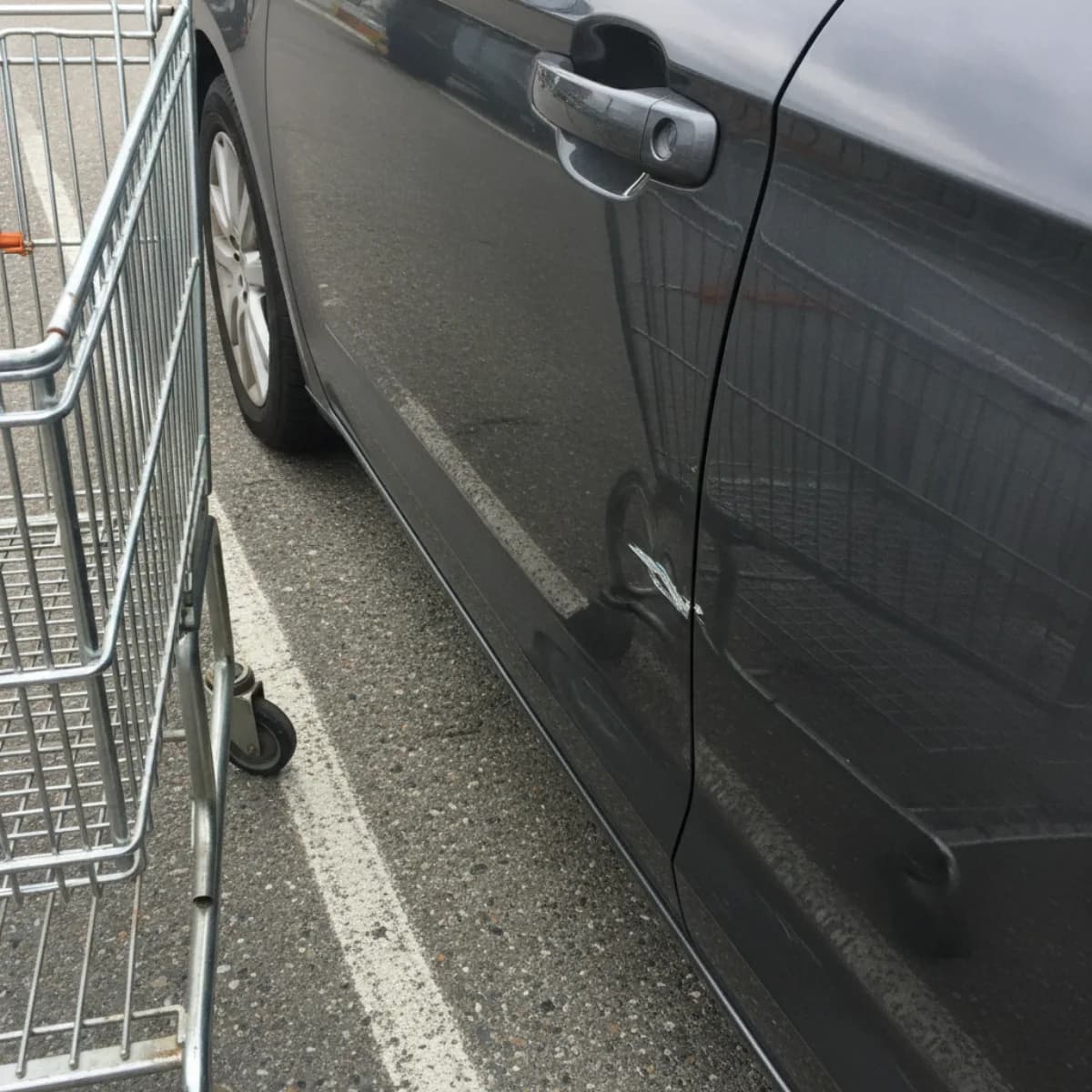

Short version: A shopping cart leaves a small, sharp dent, and small and sharp is the expensive combination. A cart corner puts its whole weight through about a square inch of your door, so the metal stretches harder in that one spot than a wide soft dent ever stretches it. Run a fingernail across it first. If the nail glides, the paint is intact and I can pull it out in your driveway. If it catches, the finish is broken and the shape work needs touch-up after. My DMV mobile rate runs $125 to $225 for a round ding on a flat panel, $200 to $350 if it lands on a body line, and $350 to $600 for a crease. And no, the store almost certainly isn't paying for it.
Why a cart dent is harder than its size suggests
A cart corner concentrates its whole load into roughly a square inch of panel, so a two-inch cart ding can hold more stretched metal than a six-inch door ding does.
A car door swings into you along its whole edge. The force spreads out, the panel gives over a wide area, and what you get is broad and shallow. That's forgiving metal. A cart hits with a corner instead: the front bumper of the basket, the child-seat frame, or the bottom rail. Tiny contact patch, all the energy in one place.
Sheet metal doesn't squash, it stretches. So the number that decides the job isn't how wide the dent looks, it's how far the metal moved and over how short a distance. A sharp dent moved a lot of metal in a very small area, and all of it has to come back without leaving a ripple.
That's why a call opens with "it's tiny, this should be quick" and I have to explain that the tiny one is the $200 job while the neighbor's dinner-plate dent was $150. It isn't upselling, it's the geometry. Fuller breakdown of the shapes in the guide to dent types.
The fingernail test tells you what you're dealing with in ten seconds
Drag a fingernail slowly across the dent. If it glides, the paint is whole and paintless repair is on the table. If it catches on an edge, the finish is split and the shape work needs touch-up after.
Do this before you call anybody, including me. Wash the spot, dry it, and run your nail across it both ways. Three things can happen.
- The nail glides, no catch. Paint's intact. This is straight paintless dent repair and your factory finish never gets touched.
- The nail catches on a line. The clear coat is split, or it's scraped down to primer. I can still bring the shape back, but the break in the finish is a separate job after. Fixing a car scratch covers that half.
- There's a grey or white smear that wipes off. That's plastic and paint from the cart sitting on top of your clear coat. It isn't damage at all. Polish it off with a rag and some compound. I've driven out for a few of these, told the customer it's a smudge, and charged nothing. It's the best call I get.
Where the cart hit you decides most of the price
Cart dents land at about door-handle height, and what they land ON, flat panel or body line, moves the price more than how wide they are.
Within cart dents, bigger still costs more. The comparison that surprises people is against a door ding: a one-inch cart dent starts about where a dinner-plate door ding tops out.
| What you're looking at | What the cart did | Comes out paintless? | My DMV rate | Time on site |
|---|---|---|---|---|
| Round ding under an inch, flat part of the door | Light touch from the basket corner | Yes | $125 to $175 | 30 to 45 min |
| Round dent one to three inches, flat panel | A loaded cart rolled into it | Yes | $150 to $225 | 45 to 60 min |
| Dent sitting on a body line | Corner caught the character line | Usually, slower | $200 to $350 | 60 to 120 min |
| Crease longer than three inches | Cart rolled along the panel, not into it | Usually, not always perfect | $350 to $600 | 90 to 180 min |
| Sharp dent with the paint cracked | Hit hard enough to split the clear coat | Shape yes, finish needs touch-up | $200 to $350 plus touch-up | 60 to 120 min |
| Dent in a plastic bumper cover | Cart into the corner of the bumper | Different method, heat and push | $150 to $300 | 45 to 90 min |
Touch-up on a split finish gets priced separately once I see the panel, and it's usually the smaller half of the bill. Those are my own mobile rates, done at your house or your office lot, not a shop estimate. If your dent came from a car door rather than a cart, the numbers sit on the door ding repair cost page instead, and bumper work has its own page at plastic bumper repair cost.
A dent on a body line is the one worth worrying about
A body line is a fold pressed into the panel that reflects a straight bar of light down the side of the car. Once that line is kinked, your eye finds it from twenty feet away.
Two things make it harder. The metal along a body line is folded, which work-hardens it, so it's stiffer and it fights back. And the line itself is a mirror. A flat panel can be 95 percent back and nobody will ever spot the last five. A body line has to be 100 percent, because the reflected highlight turns any leftover wobble into a visible bend.
That's the entire reason for the price jump in the table. If someone prices body-line work the same as a flat-panel ding, ask how many they've done. Either they've got a trick I'd like to learn, or they haven't seen one yet. What I can and can't get back is laid out in more detail in what dents PDR can fix.
Why the cheap dent puller usually makes a cart dent worse
Suction cups need a wide, shallow, smooth dent to grip, which is the exact opposite of what a cart leaves behind.
The kits come in two flavors and both struggle here. A suction cup needs surface area and a gentle curve to seal against. A sharp two-inch cart dent gives it neither, so it either won't hold or it pops off the second you pull. Glue-puller kits do grip, and that's where the trouble starts: they pull from a single point, hard, with no feel for when to stop. You trade the dent for a high spot, and a high spot is worse, because now the metal is stretched in two directions and both have to come back.
A DIY high spot on top of a cart ding routinely adds $75 to $100 to what I'd have charged for the dent alone. I'm not saying don't try it, and I'll talk you through it if you want to. I'm saying that on this dent shape the odds are bad. Which kits actually do anything is covered in do DIY dent removal kits work.
Who pays for shopping cart damage, and why it is usually you
A store isn't automatically on the hook for a loose cart. You'd have to show the business was negligent in controlling its carts, and in a parking lot that's a hard thing to prove.
It's the question I get asked most. McCue Corporation, which sells cart corrals and barriers to retailers, lays the standard out plainly for its own customers: the person whose car got hit has to prove the business was negligent in keeping the lot safe. It also notes that if a separate management company owns the lot, the duty of care sits with them, not the store.
On a Saturday afternoon that means no attendant on duty, no witness, no license plate on a cart, and wind is a perfectly good explanation for how it got moving. In twenty years across the DMV I can count on one hand the customers who got a store to write a check. Report it anyway. Customer service desk, ask for an incident report, photograph the cart and where it sits. Ten minutes, and occasionally it pays. Just don't build your plan around it.
Filing a claim on a cart dent usually costs more than the dent
A cart striking your parked car is a collision claim, not comprehensive, and collision carries the higher deductible on most policies.
The Insurance Information Institute defines collision as damage to your car from hitting an object, and gives a telephone pole, a guard rail and a mailbox as its examples. It runs the other way too: a cart rolling into your parked door is a collision loss, not comprehensive. Comprehensive is the other-than-collision bucket: theft, an animal, hail, a branch coming down.
So the claim lands on the coverage with the bigger deductible. If yours is $500 or $1,000 and the repair is $175, there is nothing to claim. The math only turns over when a cart has run a long crease down two panels, and even then it's worth pricing the repair first. More on when a claim is worth opening at all is in insurance and dent repair.
Where this happens in the DMV, and why the lot matters more than the store
Sloped lots with long runs to the cart corral produce most of the cart damage I get called out for, which is why the big-box lots generate the calls.
The addresses come up again and again: Costco down in Pentagon City, the Wegmans lots out toward Fairfax, Target at Bailey's Crossroads. What they have in common isn't the store, it's the lot. Long walks from the far spaces back to a corral, and enough grade that a cart nobody pushed will find your door on its own. Windy March afternoons are reliably my busiest cart week of the year.
One thing genuinely helps and it isn't what people expect. Everyone tries to park away from the corral. Park uphill of it instead. A loose cart rolls downhill, so sitting above the corral beats sitting beside it, and the far end of the lot only helps if it's flat.
What the appointment actually looks like
Most cart dents are one driveway visit, 30 to 90 minutes, with nothing to drop off and no rental car.
Text me two photos. One from six feet back so I can see where the dent sits on the panel, and one up close at an angle so the reflection shows me how deep it goes. That's usually enough for me to give you a real number before I drive anywhere.
Then I come to your house or your office lot, work off my own power, and you keep the car the whole time. No shop, no drop-off, no repaint. The factory paint stays factory, which is the part that matters the day you trade it in. The difference between that and a shop visit is spelled out in mobile versus shop repair.
Frequently asked questions about shopping cart dents
Can a shopping cart dent be fixed without repainting?
Usually yes. If the paint isn't broken, the metal gets worked back to shape and the factory finish is never touched. Run a fingernail across the dent. If it glides without catching, paintless repair should handle it.
How much does shopping cart dent repair cost?
My DMV mobile rate is $125 to $225 for a round ding on a flat panel, $200 to $350 if it lands on a body line, and $350 to $600 for a crease. Those are done at your driveway, not a shop estimate.
Is the store liable if a shopping cart hits my car?
Rarely. A store isn't automatically responsible. You'd have to show it was negligent in managing its carts and that this caused the damage. Report it and get an incident report on file anyway, but don't count on being reimbursed.
Should I file an insurance claim for a cart dent?
Usually not. A cart hitting your parked car is a collision claim, which carries the higher deductible on most policies. If your deductible is $500 and the repair is $175, there's nothing to claim. A long crease across two panels can change that.
Do DIY dent pullers work on shopping cart dents?
Poorly. Suction cups need a wide shallow dent and a cart leaves a small sharp one. Glue kits grip but pull too hard from one point, so you get a high spot instead. Fixing a DIY high spot adds $75 to $100 on top of the original repair.
How long does it take to fix a cart dent?
Most take 30 to 90 minutes at your driveway or office lot. A dent on a body line runs one to two hours. A long crease can go to three. Nothing gets dropped off and there's no rental car involved.
Will a cart dent hurt my car's resale value?
A visible dent gets deducted at trade-in appraisal. Paintless repair keeps the factory finish, so there's no paint work in the vehicle history and no color match to explain later. That's why pre-sale prep is a lot of my spring work.
What to do with the dent in your door right now
Run the fingernail test. Check whether it sits on a flat panel or across a body line. Then decide whether you want it gone. The store isn't paying, a claim doesn't pencil out on a small one, and the kit will probably cost you more than it saves. Send me two photos and I'll tell you which row of the table you're in before either of us spends anything.
Buster has been doing mobile paintless dent repair across the DMV for 20+ years. He pulls dents from the inside of the panel, no body shop, no repaint, factory finish stays. Most jobs done at your driveway in 1 to 2 hours.