Mobile Auto Body & PaintCall (703) 975-9626
Cost & Pricing

Minor Dent Repair Cost in 2026: DMV Mobile Pricing Guide

June 19, 2026 · 10 min read · by The Dent Dude team

PDR Vs BodyShop (and why I switched)
Practitioner walkthrough of paintless dent repair vs traditional body shop. Useful baseline for what a minor dent fix actually looks like before you decide mobile PDR vs shop quote.

Short version: A minor dent in the DMV in 2026 runs $75 to $200 mobile for a shallow ding under 1 inch, $150 to $300 mobile for a 1 to 2 inch shallow dent, $250 to $500 mobile for a 3 to 4 inch round dent, and $400 to $750 mobile for a 4 to 5 inch dent that is still shallow and has intact paint. Body shop quotes on the same damage run roughly 3 to 4 times the mobile paintless dent repair price because the shop has to mask, sand, primer, paint, and clear coat the whole panel for color match. The single biggest cost-control move on a minor dent is calling it in while the paint is still intact, before weather or rust turns a $150 mobile fix into a $700 shop repaint. After 20+ years pulling dents in driveways across Alexandria, Arlington, Fairfax, Falls Church, and McLean, here is the real cost math by size, the diagnostic that decides mobile vs body shop, what counts as minor and what does not, and the four mistakes that turn a $150 ding into a $1,200 repair.

How much does minor dent repair cost in the DMV in 2026

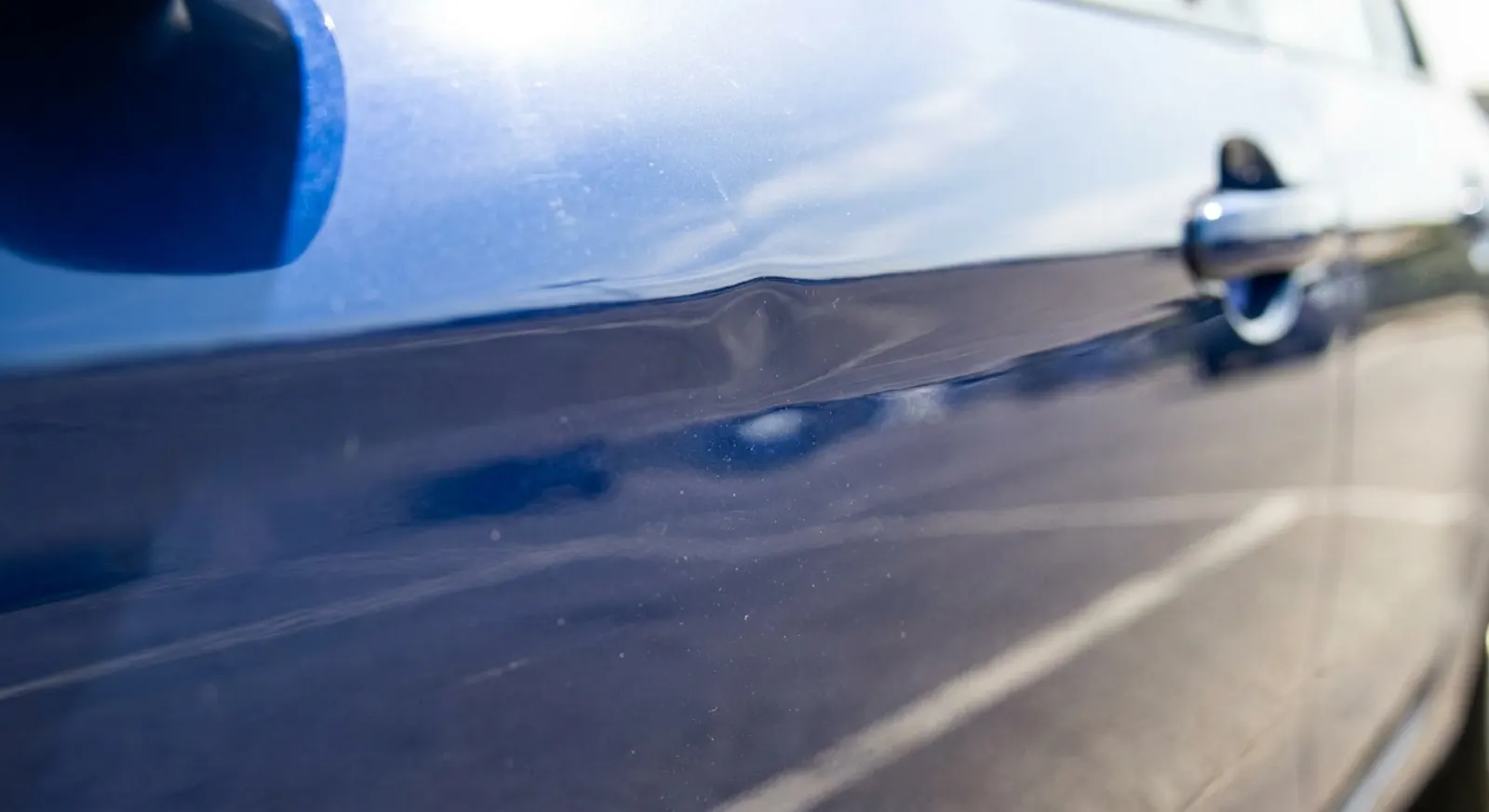
Minor dent pricing moves on four things: dent size (the longest visible diameter), dent depth (shallow, medium, or deep), paint condition (intact, chipped, or torn), and panel location (flat center of a door is cheap, edge of a panel or body line is more). The table below is what I actually charge mobile in DMV driveways for the work that stays cleanly in the minor-dent category, what the body shops up the road quote on the same damage, and the time on each.

Minor dent typeMobile PDR (DMV)Body shop quoteTime
Shopping cart ding, under 1 inch, paint intact$75 to $150$400 to $70030 to 45 min
Door ding, 1 to 2 inches, shallow, paint intact$150 to $250$500 to $85045 to 75 min
Round dent, 2 to 3 inches, shallow$200 to $350$700 to $1,00060 to 90 min
Round dent, 3 to 4 inches, shallow$250 to $500$800 to $1,20075 min to 2 hours
Round dent, 4 to 5 inches, shallow, intact paint$400 to $750$1,000 to $1,50090 min to 2.5 hours
Cluster of 2 to 4 small dings, one visit$200 to $450$700 to $1,10090 min to 2 hours
Minor edge dent on the lip of a panel$250 to $500$800 to $1,30060 to 90 min
Minor body line dent, no clear coat crack$300 to $600$900 to $1,40075 min to 2 hours
Aluminum panel surcharge (F-150, Tesla, Audi, Porsche)Add 25 to 50 percentAdd $200 to $500Add 30 to 60 min

These ranges hold for steel panels with intact paint, where the metal has not stretched past its elastic limit and the back of the panel is accessible through trim removal or window-channel access. Once a dent crosses 5 inches in diameter, or the paint has torn through to bare metal, or a sharp crease runs through a body line and cracks the clear coat, the job is no longer minor and the pricing structure shifts. For larger dents and creases see how much does paintless dent repair cost, for door-zone-specific pricing see car door dent repair cost, and for the method-comparison math across PDR, body shop, and DIY see dent removal cost.

What actually counts as a minor dent

The word "minor" gets used loosely. In real pricing terms, a minor dent passes all four of these conditions at the same time:

  1. Size under 5 inches at the longest visible diameter. Anything past 5 inches moves into the medium-or-large category where pricing climbs faster and the time on the job doubles.
  2. Shallow depth, no oil-canning. Press the panel around the dent with a flat palm. If it pops in and out (the oil-canning sound), the metal has stretched past its elastic limit and the dent is no longer minor regardless of size.
  3. Paint film intact. Drag a fingernail across the dent edge. If your nail does not catch on a chip, lifted clear coat, or torn paint, the paint is intact and paintless dent repair stays in play. If your nail catches, the paint has broken and the job needs touch-up at minimum or body shop at worst.
  4. Not through a body line or sharp edge. A dent that runs across a body line (the sharp horizontal crease on a fender or door) usually cracks the clear coat right at the line even when the surrounding paint looks intact. Body-line dents move out of minor pricing because the clear coat has to be touched up.

If all four conditions hold, the dent is genuinely minor and the price stays in the table above. If even one condition fails, the dent moves into the medium category and the price climbs roughly 2 to 3 times the minor range. The diagnostic takes 60 seconds in your driveway and it is the first thing I do before I quote anything. For the broader dent diagnostic across all sizes and types see types of car dents and what dents can PDR fix.

Minor dent repair cost by size: under 1 inch, 1 to 2, 2 to 3, 3 to 4, 4 to 5

Size is the single biggest input to minor dent pricing. The mobile DMV math by size, holding depth shallow and paint intact:

Under 1 inch (shopping cart ding, parking lot mark). $75 to $150 mobile in your driveway. Most jobs in this range finish in 30 to 45 minutes from rod-in to walkaway. The dent is small enough that I usually quote a flat $100 unless the access route requires pulling the door card. Body shop quote on the same damage: $400 to $700 because the shop has to respray the panel for color match. This is the cheapest fix on the whole price list because the rod path is short and the pull is clean.

1 to 2 inches (door ding, light contact). $150 to $250 mobile, 45 to 75 minutes. The most common DMV call I get. Usually a shopping cart got pushed into a parked car or another driver opened a door into yours in a tight lot. The pull is straightforward on flat panel sections and slightly more time on the curve of a fender or quarter. Body shop on the same damage: $500 to $850.

2 to 3 inches, shallow. $200 to $350 mobile, 60 to 90 minutes. This is where the rod work takes longer because the dent has more surface area to work back to flush. The pull happens in 4 to 6 passes rather than 1 to 2 because pushing too hard in one spot creates a high spot that has to be tapped back. Body shop on the same damage: $700 to $1,000.

3 to 4 inches, shallow. $250 to $500 mobile, 75 minutes to 2 hours. Still firmly in minor territory if the depth is shallow and the paint is intact. The pricing range widens because access matters more (a flat door panel is at the low end, an edge near a wheel arch is at the high end). Body shop: $800 to $1,200.

4 to 5 inches, shallow with intact paint. $400 to $750 mobile, 90 minutes to 2.5 hours. This is the upper edge of minor pricing. If the dent is 5 inches and still shallow with intact paint, it stays in minor. If it is 5 inches and oil-canning or has any paint damage, it crosses into medium territory and pricing climbs to $700 to $1,200 mobile. Body shop on the 4 to 5 inch range: $1,000 to $1,500.

Why mobile paintless dent repair beats the body shop on minor dents

On a minor dent with intact paint, mobile paintless dent repair wins on five fronts and the body shop wins on zero. Price: PDR runs 25 to 35 percent of the body shop quote on the same damage because PDR has no paint, primer, clear coat, or booth cost. Time: 45 minutes to 2 hours in your driveway versus 3 to 7 business days at a body shop with a rental-car gap in the middle. Paint preservation: PDR keeps the factory paint film, factory clear coat, and factory thickness intact. Body shop work always shows up on a Carfax body-and-paint search and lowers resale value by $400 to $1,200 at trade-in or private sale. Convenience: I come to your house, office, or wherever the car is parked. No tow, no rental, no drop-off. Insurance footprint: PDR jobs almost never get filed under insurance because the price is under most deductibles. Body shop jobs at $1,000-plus often get filed, which can trigger a renewal surcharge in Virginia and Maryland of $150 to $400 per year for 3 years.

The body shop wins on minor dents only when the paint is already torn or the customer wants the panel fully replaced for documentation reasons (lease return where any repair history disqualifies the car, pre-sale photo prep where the buyer wants a written paint history). In every other minor-dent case, PDR is the right call and the savings vs the body shop quote land between $300 and $900 per dent. For the head-to-head comparison see PDR vs body shop, what is the difference and mobile vs shop paintless dent repair.

DIY minor dent repair: when it honestly works and when it costs more

DIY honestly works on one narrow class of minor dent: a shallow round dent under 3 inches, on a flat panel section (not a body line, not a corner, not an edge), with fully intact paint and an accessible panel back. On that class, a $30 suction-cup kit from a parts store or a clean cup-plunger pull will pop the dent flush in 15 minutes about 50 percent of the time. The hot water plus compressed air trick (pour boiling water over the dent, immediately spray inverted compressed air to flash-cool) works on shallow round dents on plastic bumpers about 40 percent of the time.

Outside that narrow class, DIY makes the panel worse half the time and turns a cheap PDR fix into an expensive body shop repaint. Three failure modes I see in DMV driveways week after week. Suction kit on a body line. The puller stretches the metal unevenly, the panel oil-cans, and a $200 PDR job becomes a $900 body shop respray. Glue-pulling kit used on a textured paint or matte finish. The glue residue burns into the clear coat or matte surface and a body shop has to wet-sand the panel ($150 to $400 to remove the residue) before the actual dent gets fixed. Touch-up paint pen over an unpulled dent. The pen leaves a visible paint blob over the depression that shows up in any direct sunlight, and the only fix is sanding plus full panel respray.

The honest DIY math: a successful DIY saves $100 to $200 against a mobile PDR call. A failed DIY costs $500 to $1,500 extra against a mobile PDR call because the panel now needs paint work that the PDR fix would have avoided. The 50/50 outcome means the expected cost of trying DIY on anything outside the narrow shallow-round-on-flat-panel class is higher than just calling PDR. For when DIY is honestly worth the risk see how to get a dent out of a car.

The 3-question test I run before quoting any minor dent

Before I price a minor dent in your driveway, I run the same three questions in the same order. They take 60 seconds and they decide mobile PDR, mobile PDR with light touch-up, or body shop without guessing.

Question one: is the paint intact? Drag a fingernail across the dent edge. If the nail does not catch on a chip, lifted clear coat, or any rough edge, the paint is intact and mobile paintless dent repair stays in play at the minor-dent rate. If the nail catches, the clear coat or color coat has broken, and either a small touch-up adds $50 to $150 to the PDR price, or the job moves to body shop territory if the break is larger than a pencil eraser.

Question two: does the metal oil-can? Press the dent area firmly with a flat palm. If the panel pops in and out (you can feel and hear it click), the metal has stretched past its elastic limit and the dent is no longer minor regardless of the visible diameter. Oil-canning dents either need a more time-intensive PDR pull at $400 to $800 (twice the minor rate) or move to body shop territory if the panel is permanently deformed.

Question three: does the dent run through a body line? Look at the sharp horizontal crease that runs along the fender or door (the body line). If the dent crosses the body line and you can see the clear coat has cracked along the line itself (a thin hairline running parallel to the line), the job needs touch-up at minimum, and on luxury paint codes (Tesla Pearl White Multi-Coat, Audi Nardo Grey, Porsche Crayon, BMW Frozen) it usually moves to body shop because the touch-up will not blend invisibly. If the dent crosses the body line but the clear coat is still intact, mobile PDR holds at the upper end of the minor range.

What about minor dents with paint damage

Once the paint film breaks, the job is no longer pure paintless dent repair. There are three honest paths and the right one depends on how much paint actually came off. Tiny chip with rust starting (smaller than a pencil eraser). Mobile PDR plus touch-up: $150 to $350 total. I pull the dent with the rod, then color-match the chip with factory paint code and feather the edges. Done at your driveway in 90 minutes. For the chip-specific math see paint chip repair cost. Medium chip (pencil eraser to quarter sized). Mobile PDR plus a larger touch-up runs $250 to $550 if the panel is steel and the color is a common code. Luxury color codes add $150 to $300. Torn paint larger than a quarter or cracked clear coat across more than an inch. Body shop territory, $700 to $1,400 for the full mask-sand-primer-paint-clear sequence. The break-even rule: if the paint damage costs more to color-match than the dent costs to pull, the body shop fix is the honest answer.

The trap to avoid: do not let a small paint chip sit unfixed through a DMV winter. Salt brine and freeze-thaw cycles turn a $20 surface rust chip into a $300 scale rust repair in 60 to 90 days. The cheapest minor-dent-plus-chip fix is always the one done in the first 2 weeks after the damage. For the rust-progression math see car rust repair cost.

Aluminum panels: the surcharge that catches customers by surprise

If your car has aluminum body panels, the minor dent fix runs 25 to 50 percent more than steel because aluminum work-hardens during the pull (it pushes back harder, the rod work takes more passes, and the panel needs heat induction to stay workable). Cars with aluminum panels common in the DMV: Ford F-150 from 2015 forward (full aluminum body), Tesla Model S, Model X, Model Y rear quarter panels and front fenders, late Lexus IS, ES, LS select years, Audi A6, A7, A8, BMW M3, M4, M5, Porsche 911, Jaguar XE and XF, and Range Rover.

The mobile DMV math: a 2 inch shallow door ding on a steel panel is $150 to $250. The same dent on an aluminum F-150 door is $200 to $350. A 3 to 4 inch shallow dent on a Tesla Model Y rear quarter (aluminum) runs $350 to $650 against $250 to $500 on a steel sedan. The surcharge is honest math, not a markup. For the full aluminum panel context see aluminum body panel PDR and for Tesla-specific paint and panel considerations see Tesla dent repair.

Insurance: when to file and when to pay cash for a minor dent

For minor dents, cash pay almost always wins over filing insurance. Three reasons. Reason one: the dent fix is under your deductible. Standard Virginia, Maryland, and DC collision deductibles run $500, $750, or $1,000. Almost every minor dent in the table above costs less than $500 mobile, so the deductible eats the entire claim and you get nothing back. Reason two: filing a claim under $1,500 typically triggers a renewal surcharge. The carrier passes the cost back to you over the next 3 years at $150 to $400 per year, which usually exceeds the claim payout. Reason three: minor dent damage is almost always a single-party comprehensive-or-collision claim with no other driver to assign fault to, which means the surcharge falls on your policy with no way to shift it.

The narrow exception where filing makes sense: a multi-panel hit with both dent and torn paint where the body shop quote runs over $2,500 and the at-fault driver is identified (their carrier pays, no surcharge on you). For the full insurance decision math on bigger damage see insurance and dent repair and for the hail-claim version see hail damage, insurance claim or cash.

Real DMV minor dent jobs I quoted this month

The pricing above is built from work I do every week. Three jobs from the past two weeks across the DMV that show the size-and-paint diagnostic in action:

Pentagon City, 2021 Honda Accord, Crystal Black Pearl. Customer noticed a 1.5 inch shopping cart ding on the rear passenger door, paint fully intact. Quick fingernail test: no catch. Panel pressed: no oil-canning. Mobile PDR at her parking garage spot. 50 minutes from rod-in to walkaway. Total: $180. Honda dealer service had quoted $750 for full door respray. The factory Crystal Black Pearl stayed untouched and the dent is invisible at 3 feet.

Old Town Alexandria, 2019 Audi Q5, Mythos Black. Customer had two dings on the same fender from a parking lot incident, one 2 inches and one 1 inch, both shallow, paint intact on both. Pressed each: neither oil-canned. Cluster job, both in one visit at his driveway. Total: $290, 90 minutes. Audi service had quoted $1,250 for full fender respray plus paint blend. Factory Mythos Black is a deep solid color that body shops struggle to color-match cleanly, so the PDR fix was both cheaper and visually better.

Falls Church, 2017 Ford F-150 XLT, Magnetic Gray. Customer had a 4 inch shallow dent on the aluminum bed rail from a tree branch fall. Paint intact, no oil-canning, dent did not cross the body line. Aluminum surcharge applied. Mobile PDR at his driveway. 2 hours from start to walkaway. Total: $550. Ford dealer had quoted $1,400 for bed rail respray. The 25 to 50 percent aluminum surcharge over the steel rate is honest because the rod work took 2 hours instead of the 75 minutes a steel panel would have taken.

FAQs about minor dent repair cost

What counts as a minor dent?

A dent is minor when all four conditions hold: size under 5 inches at the longest visible diameter, shallow depth with no oil-canning when you press the panel, paint film fully intact (a fingernail does not catch on the dent edge), and the dent does not run through a sharp body line. If even one condition fails, the dent moves into the medium category and pricing roughly doubles to triples.

How much does a small dent cost to fix in 2026?

A small dent under 1 inch with intact paint runs $75 to $150 mobile in DMV driveways, finished in 30 to 45 minutes. A 1 to 2 inch shallow ding runs $150 to $250 mobile, 45 to 75 minutes. The same dents quoted at a DMV body shop run $400 to $850 because the shop has to respray the panel for color match.

Can a minor dent be fixed without painting?

Yes if the paint film is intact. Drag a fingernail across the dent edge. If the nail does not catch on a chip or lifted clear coat, the paint is intact and paintless dent repair pulls the dent without paint, primer, clear coat, or filler. If the nail catches, the clear coat or color has broken and the job needs touch-up at minimum.

Is it worth fixing a minor dent on an older car?

Almost always yes for minor dents under $300 mobile because the fix protects $400 to $900 of resale value at trade-in or private sale on most DMV daily drivers. The math gets less clear once the mobile fix climbs over $500 on a car worth under $5,000, where the repair is approaching 10 percent of the car's market value. For lease-return prep, fixing every minor dent before turn-in usually saves $500 to $1,200 in lease-end damage charges.

How long does minor dent repair take?

Mobile paintless dent repair on a single minor dent runs 30 to 45 minutes for under 1 inch, 45 to 75 minutes for 1 to 2 inches, 60 to 90 minutes for 2 to 3 inches, 75 minutes to 2 hours for 3 to 4 inches, and 90 minutes to 2.5 hours for 4 to 5 inches with intact paint. Body shop turnaround on the same damage runs 3 to 7 business days because of paint cure time and booth scheduling.

Should I file insurance for a minor dent?

Almost never. Minor dent fixes mostly run under $500 mobile, which is below standard Virginia, Maryland, and DC deductibles ($500, $750, or $1,000). Filing a claim under $1,500 typically triggers a renewal surcharge of $150 to $400 per year for 3 years that exceeds the payout. Cash pay wins on minor dents unless the damage is multi-panel with an at-fault driver identified.

What is the cheapest way to fix a small dent on my car?

Mobile paintless dent repair is the cheapest honest fix on a minor dent with intact paint, running $75 to $250 for dents under 2 inches. DIY suction kits and the hot water plus compressed air trick work about 50 percent of the time on shallow round dents on flat panels with intact paint, but failure costs $500 to $1,500 extra because the failed DIY usually forces a body shop repaint. Outside the narrow DIY win class, mobile PDR is both cheaper and lower risk.

Does the dent location on the panel change the price?

Yes. A minor dent on the flat center of a door is the low end of the per-size range. The same dent on the curve of a fender, the lip of a panel, near a wheel arch, or close to a body line is the high end because access takes longer or the rod path is more constrained. Edge dents on the lip of a panel run $250 to $500 mobile even when the dent itself is only 2 to 3 inches because the lip requires careful pull control to avoid stretching.

Will a minor dent get worse if I wait?

The dent itself does not grow. The risk is paint damage and rust. If the dent has any tiny chip or lifted clear coat, DMV winter salt brine and freeze-thaw cycles turn a $20 surface chip into a $300 scale rust repair in 60 to 90 days. If the paint is fully intact, the dent can wait safely, but mobile PDR pricing typically goes up 5 to 8 percent per year so the cheap fix gets less cheap over time.

Get a real minor dent quote in 30 minutes

If you have a minor dent and want a real price before you commit, send three photos: one straight-on of the dent from 2 feet, one angled to show the depth (45 degrees with light raking across the panel), and one of a fingernail dragged across the dent edge to confirm the paint is intact. With those three photos I can tell you within 30 minutes whether it is a $100 mobile fix, a $300 mobile fix, or a job that needs a body shop. Mobile paintless dent repair comes to you across Alexandria, Arlington, Fairfax, Falls Church, and McLean. Most minor dents finish in your driveway in 45 minutes to 2 hours with the factory paint film intact.

Buster has been doing mobile paintless dent repair and auto body and paint work across the DMV for 20+ years. He pulls dents at your driveway. No body shop, no repaint, factory finish stays. Most jobs done in 1 to 2 hours.

Got a dent? Get a free quote.

Text a photo to (703) 975-9626. We respond in minutes.

Call NowFree Estimate